
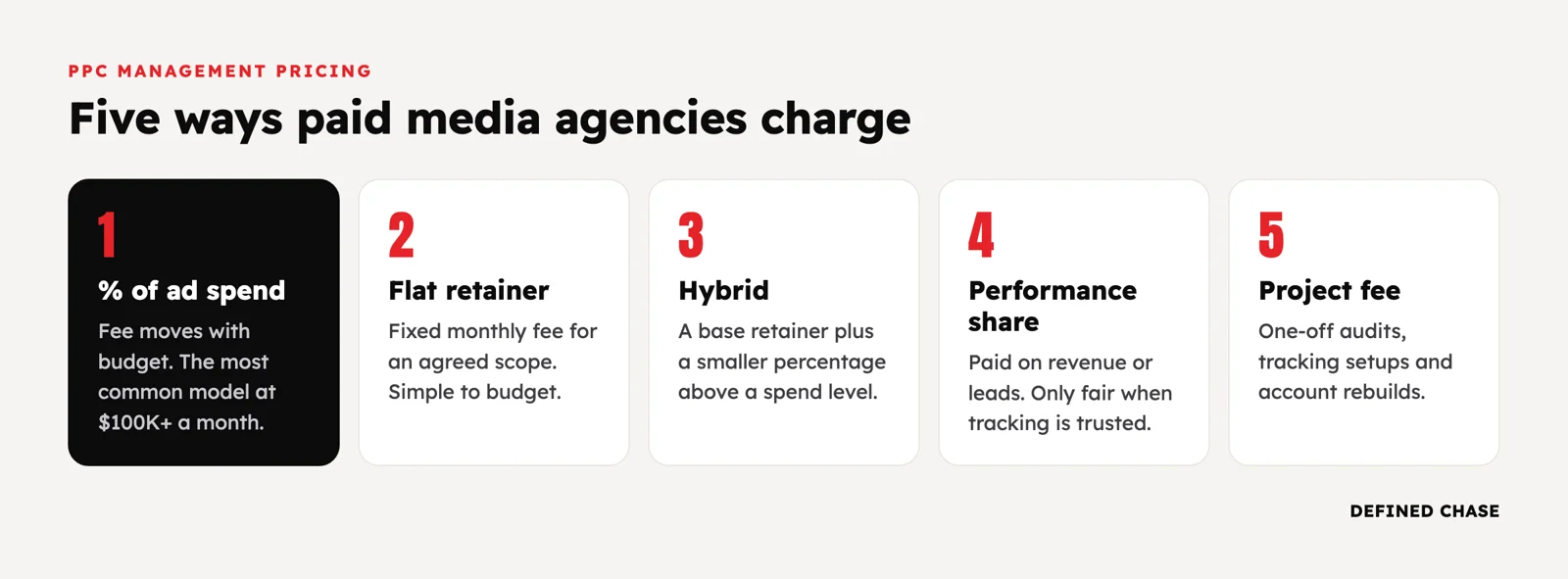
Short answer: paid media agencies charge in five ways: a percentage of ad spend, a flat monthly retainer, a hybrid of the two, a performance or revenue share, or a one-off project fee for audits and setups. Once you spend $100,000 or more a month, the model matters less than what the fee buys: a team that owns strategy, tracking, creative testing and budget decisions, and clear rules for when spend goes up. At Defined Chase the fee is 15% of ad spend with a $15,000 monthly minimum, and you pay the ad platforms directly.
This guide is for founders, CMOs and heads of growth comparing agency proposals at six or seven figures of monthly ad spend. It explains how PPC management pricing works, what a fair fee should include, and how to tell a cheap proposal from an expensive mistake. It is written from how we price and run paid media at Defined Chase.
How do paid media agencies charge?
| Pricing model | How it works | Fits when | Watch out for |
|---|---|---|---|
| Percentage of ad spend | The fee is a share of the monthly media budget, usually with a monthly minimum | Spend is growing and the work grows with it: more markets, more creative, more channels | An agency that pushes spend without rules for when the next step is safe |
| Flat monthly retainer | A fixed fee for an agreed scope, whatever you spend | Budgets are stable and the scope is easy to define | Scope creep, or a team that quietly does less once spend doubles |
| Hybrid (base plus percentage) | A fixed base covers the core team, plus a percentage above a spend threshold | You want a predictable floor and a fee that scales with the work | Thresholds and bands that are hard to compare across proposals |
| Performance or revenue share | The fee depends on results, such as a share of revenue or a fee per customer | Tracking is clean and both sides agree on how a result is measured | Arguments over attribution; agencies chasing cheap, low-quality conversions |
| Project or audit fee | A one-off price for an audit, a tracking build or a strategy | You need a diagnosis or a plan your own team will execute | A document that gets filed away with nobody accountable for the result |
Hourly billing exists too, mostly for consultants and advisory work. At $100,000 a month and above it is rare for full management, because the agency carries ongoing responsibility, not a number of hours.
What does PPC management cost at $100K+ a month?
There is no list price for the market, and fees vary by country, number of channels and what is included. As a rough guide from proposals we see brands compare, full-service management at this level tends to land in the single-digit to mid-teens percentage of spend, or in the low-to-mid five figures a month as a flat fee. Those ranges are illustrative, not a benchmark study.
The better question is what the fee is buying. Two proposals with the same price can mean very different things:
- Proposal A: one media buyer who manages bids and budgets across Google and Meta, with a monthly report.
- Proposal B: a strategy lead, platform specialists, a creative strategist writing new briefs every week, an analyst who checks tracking against real sales, landing page tests, and a written decision every week on where the next dollar goes.
At $100,000 a month, Proposal A is often the more expensive one, because nobody owns the problems that actually cap growth: tracking you cannot trust, creative that runs out, and budgets raised on last week’s ROAS.
Percentage of ad spend vs flat retainer: which is better?
The case for a percentage of spend
The work really does grow with the budget. Going from $150,000 to $400,000 a month usually means more markets, more campaigns, more creative to brief and test, more tracking edge cases, and more money at risk in every decision. A percentage keeps the agency staffed for that growth without renegotiating the contract every quarter.
The case against it
The obvious conflict: an agency paid on spend earns more when you spend more. That only becomes a problem when there are no rules for when spend should go up. The fix is not a different fee model. It is an agreed gate: a written target (for example a marginal cost per customer, or a payback period), measured on your own sales data, that has to hold before the budget increases.
When a retainer makes more sense
If your budget is flat, your channel mix is settled, and you mainly need execution, a fixed retainer is simpler. Just write down what happens to scope and team size if spend grows by half, because it usually does once things work.
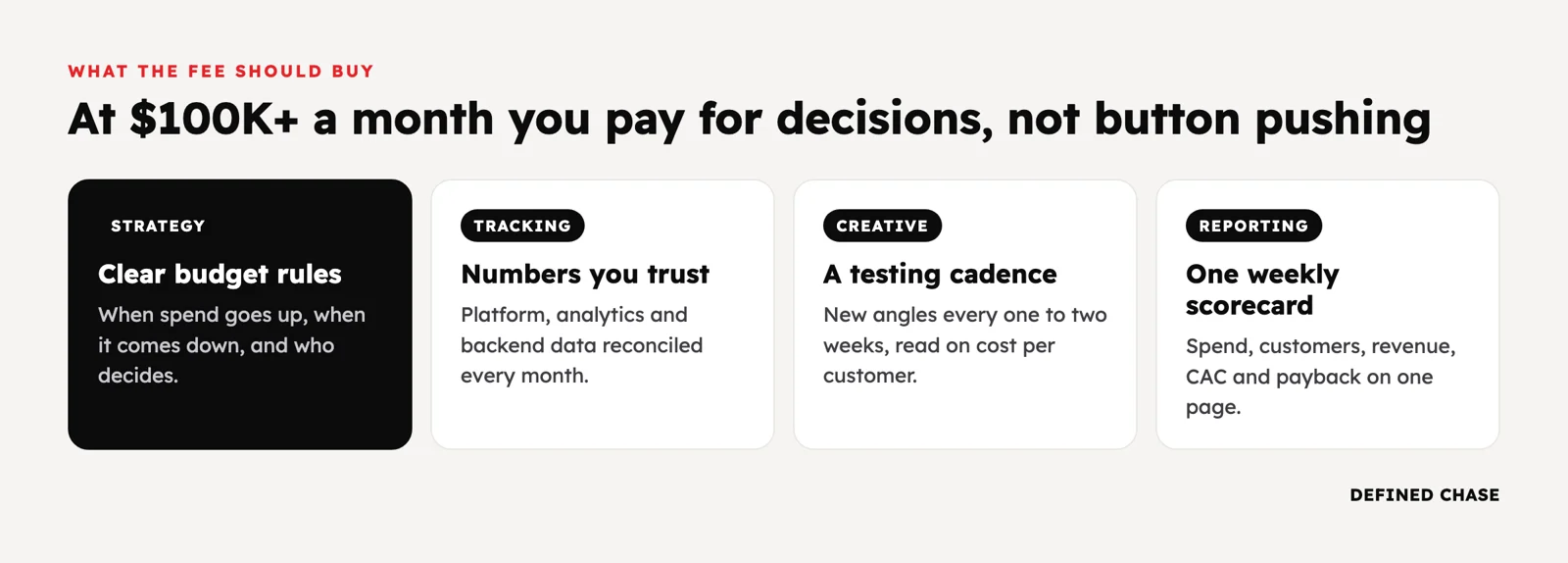
What should the fee include at this budget?
| Area | What good looks like at $100K+ a month | Ask the agency |
|---|---|---|
| Strategy and ownership | One named strategy lead accountable for the plan and the result | Who decides where the next $50,000 goes, and how? |
| Tracking and measurement | Platform numbers checked against orders, CRM or billing; server-side events and offline conversions where needed | How do you know the conversions we optimize to are real? |
| Creative | New angles, hooks and full ad briefs every week, with rules for what gets killed and what earns budget | How many new concepts do you brief a month, and who makes them? |
| Landing pages and funnel | Test briefs, requirements and readouts, even if your team builds the pages | What did your last landing page test change? |
| Reporting and decisions | Live dashboards plus a written decision update, not just a deck of charts | What decision did last month’s report lead to? |
| Budget rules | A written gate for when spend goes up, measured on your data | What would make you tell us to spend less? |
Worked example: the fee against one better decision
Illustrative numbers, not a client result. A subscription brand spends $300,000 a month on paid media at a blended cost per customer of $150. That buys 2,000 new customers a month.
- Fixing tracking so Meta and Google learn from paying customers, and moving budget away from campaigns with the worst marginal cost, brings blended cost per customer to $135 at the same spend.
- $300,000 divided by $135 is about 2,222 customers. That is roughly 222 more customers a month for the same budget.
- If each customer is worth $400 in gross profit in the first year, that is close to $89,000 of extra first-year gross profit, every month.
That is why we tell buyers to judge an agency fee against the value of the decisions it buys, not against the cheapest quote. One better decision a quarter usually pays for the whole engagement. One bad scaling decision, like doubling spend on numbers that were never real, can cost more than a year of fees.
Agency, in-house team or freelancer?
| Your situation | Usually the best fit | Why |
|---|---|---|
| One channel, stable budget, simple funnel | Freelancer or one in-house buyer | The job is execution, and a full team would be overhead |
| Strong in-house team that needs a second opinion before a big budget step | An audit or a written growth map | Your team executes; you pay for the diagnosis and the fix order |
| $100K+ a month across several channels, growth has stalled or is getting expensive | Full-service agency partnership | You need strategy, tracking, creative and budget rules owned together |
| Multi-million monthly budgets with a mature team | In-house core plus a specialist partner | Keep daily execution close; bring in depth for measurement, new channels and scale decisions |
When you compare costs, compare full cost. An in-house team of a senior media buyer, an analyst and a creative strategist means three salaries, tools, management time and the risk of one person leaving. A freelancer can be cheaper per month and still be expensive if nobody owns tracking or creative.
Common mistakes when comparing agency pricing
- Comparing headline fees, not scope. A lower fee that leaves out tracking and creative strategy just moves those costs to your team.
- Letting media spend run through the agency. Pay the platforms directly. It keeps markups visible and the accounts in your name.
- Letting the agency own the ad accounts. Accounts, pixels, tag manager containers and data should belong to you from day one.
- Signing a long contract with no exit rule. A long term is fine when it comes with a measurable review point and a clear way out if the target is missed.
- Buying an audit nobody executes. Ask who is accountable for turning findings into results.
- No rule for when spend goes up. Without one, a percentage fee and a retainer both drift into the same problem.
How we price at Defined Chase
We work with brands that spend $100,000 or more a month on ads and want to spend more, profitably. Our partnership fee is 15% of ad spend, with a $15,000 monthly minimum, in US dollars. You pay Google, Meta and the other platforms directly. We bill monthly in advance on the agreed budget, and the next invoice corrects to actual spend.
The fee covers a team, not a freelancer: a strategy lead, an account lead as your point of contact, platform specialists, a creative strategist and an analyst. We run your campaigns from day one, fix what caps growth (tracking, creative, landing pages, channel mix), and increase spend only when an agreed Scale Gate holds on your own data. The agreement runs 12 months and is gated at day 90.
Proof we can share publicly: Tinggly’s Chief Growth Officer wrote in a verified Clutch review that after we rebuilt their Google Ads account, ROAS grew from 1.5 to 2.5 and CPA fell from $105 to $84 in the first three months. We have managed and analyzed more than $100M in ad spend over 13+ years. More in our case studies.
See how we work, what is included and smaller ways to start, or book a free 90-Day Growth Map Call to find the one constraint on your next budget step.
FAQ
What is a typical PPC management fee?
It depends on spend, channels and scope. Smaller accounts are often charged a higher percentage or a flat fee. At $100,000 a month and above, most full-service proposals are either a percentage of spend with a monthly minimum or a hybrid of a base fee plus a percentage. Compare what is included before you compare the number.
Is a percentage of ad spend a fair way to pay an agency?
It is fair when the work grows with the budget and when spend only goes up against an agreed target measured on your own data. Without that rule, any fee model can reward spending more for its own sake.
Should our ad spend be paid through the agency?
We recommend paying the platforms directly. Your card or invoice account sits on the ad accounts, you see every dollar of media, and the agency fee stays separate and visible.
Who should own the ad accounts and tracking?
You should. The ad accounts, pixels, tag manager containers, analytics properties and creative files belong to the brand. A good agency works inside your accounts with admin access, so nothing is lost if you part ways.
How do I compare two agency proposals?
Put them side by side on the same questions: who owns strategy, how tracking is checked against real sales, how many new creative concepts are briefed a month, what the reporting decides, how the budget rules work, and what happens if the target is missed at the first review.
When is an agency cheaper than building an in-house team?
Usually when you need several skills at once (strategy, platform depth, tracking, creative strategy and analysis) but not a full-time person for each. If one person could do the job well, hiring them is often cheaper.
Updated 16 October 2026.
Want to scale your ad spend?
On a free Growth Map Call we find what is capping your ad spend and the next 1 to 3 steps.
Attend a Growth Map CallRelated articles
Why Customer Acquisition Cost Rises When You Scale Ads (and What to Fix First)
Short answer: customer acquisition cost rises when you scale ads because every extra dollar reaches people who are less likely to buy,…
Oct 16, 2026 · 7 min readMaximizing ROI on Your E-Commerce Website: Simple Tips and Tricks
Discover simple tips and tricks to maximize the return on investment (ROI) on your e-commerce website. Boost your online sales with these…
Jun 7, 2024 · 19 min readExpert Techniques for Optimizing Digital Campaign Performance
Discover expert techniques to optimize the performance of your digital campaigns. Maximize your ROI and achieve better results with these strategies.
Jun 2, 2024 · 9 min read