
Short answer: customer acquisition cost rises when you scale ads because every extra dollar reaches people who are less likely to buy, the same people see your ads more often, creative wears out, and the platforms keep optimizing to whatever signal you send them, right or wrong. Average CAC hides this, because it blends cheap early customers with expensive new ones. Before you raise the budget, check four things: tracking against real sales, creative volume, landing page and offer conversion, and marginal CAC by channel. Then scale in steps, and only while marginal CAC stays inside your target.
This guide is for brands spending $100,000 or more a month on paid media that see costs climb every time they push. It uses Meta as the main example because that is where we hear the complaint most, but the same logic applies to Google, TikTok and app networks.
What is customer acquisition cost, and which CAC matters when you scale?
Customer acquisition cost is what you spend to win one new paying customer. The basic formula is acquisition spend divided by new customers in the same period. The trouble is that there are several versions of it, and each answers a different question.
| Metric | How it is calculated | What it tells you | Where it misleads |
|---|---|---|---|
| Blended CAC | All marketing spend divided by all new customers, from any source | Whether the business as a whole acquires customers profitably | Organic, referral and brand demand make paid look better than it is |
| Paid CAC | Paid media spend divided by new customers attributed to paid | Whether paid media pays back on its own | Depends on attribution you may not trust |
| Platform CPA | What Meta or Google reports per conversion | How the algorithm sees your campaigns | Counts the platform’s own conversions, often more than really happened |
| Marginal CAC | Extra spend divided by extra customers between two budget levels | What the next budget step actually buys | Needs clean before-and-after periods to read well |
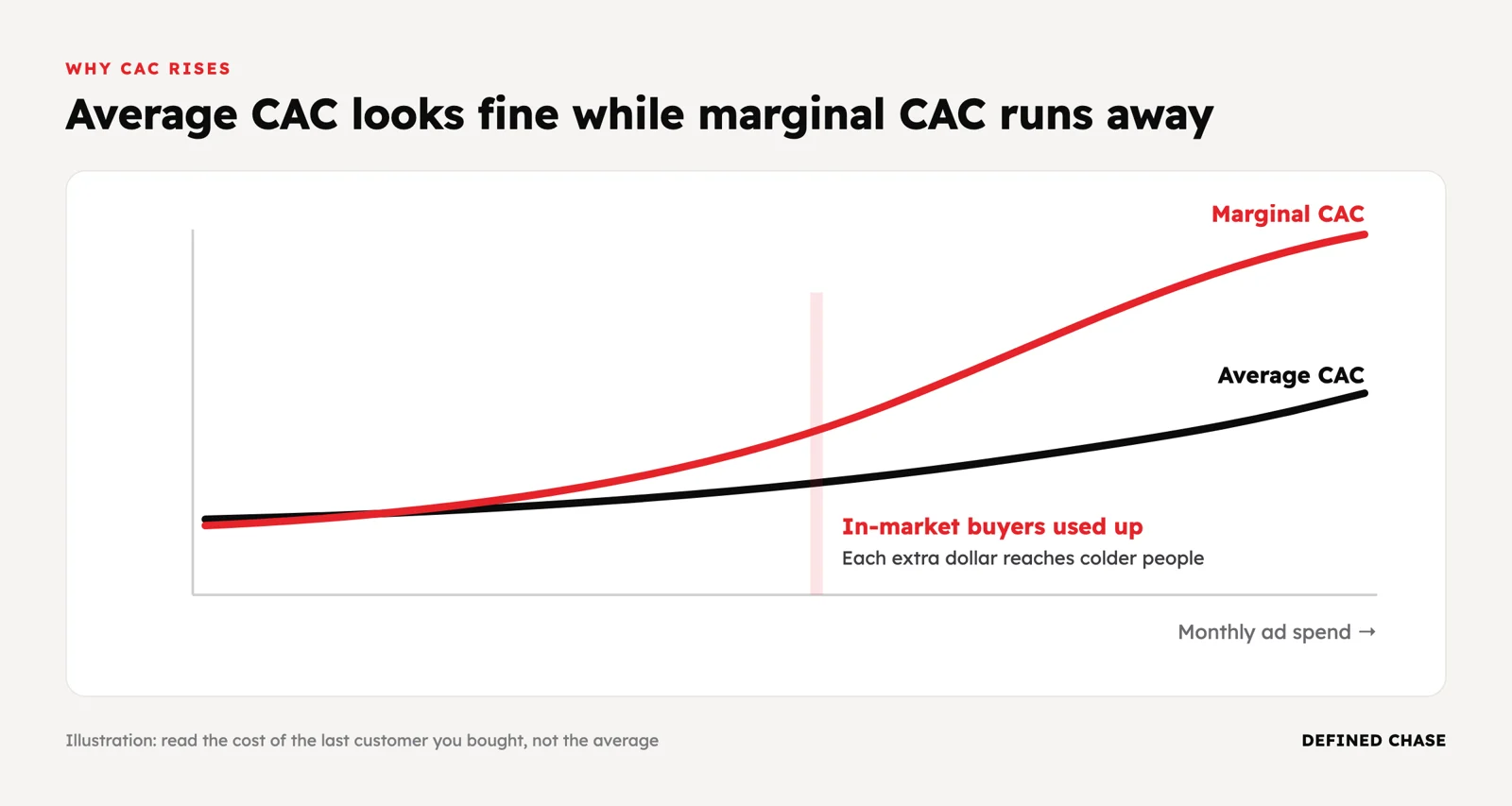
When you are deciding whether to scale, marginal CAC is the number that matters. Your average can look fine while the last $50,000 you added bought customers at twice the price.
Why does CAC rise as you scale ad spend?
1. Diminishing returns on the audience
Platforms show your ads to the most likely buyers first. As you spend more, they reach further into people who are less ready, less qualified or less interested. That is normal. The question is how fast it happens and whether the customers you add are still worth what you pay for them.
2. Frequency and creative fatigue
More budget on the same creative means the same people see the same ads more often. Click-through falls, cost per result climbs, and the account looks like it is “saturated” when it is really short of new angles. At $100,000 a month and above, most accounts need new concepts every week, not every quarter.
3. The algorithm learns from the wrong signal
Meta and Google bid on the event you send them. If that event is a sign-up, an add-to-cart or a purchase that includes refunds and existing customers, the platform gets very good at finding more of that, not more profitable customers. Scaling amplifies whatever the signal rewards.
4. Conversion on the page does not scale with traffic
New audiences arrive with less context than your first buyers. If the landing page and offer were built for warm traffic, conversion rate drops as you reach colder people, and CAC rises even when media costs hold.
5. Attribution makes it look worse, or better, than it is
When several channels claim the same customer, the total of platform-reported conversions can exceed your real sales. Teams then cut or scale the wrong campaigns. Fixing the numbers often changes which channel looks expensive.
Why CAC rises when you scale Meta ads specifically
- Big budget jumps restart learning. Large or frequent edits push ad sets back into the learning phase, and costs are unstable until delivery settles again.
- Broad targeting depends on creative. With Advantage+ and broad audiences, the creative is the targeting. Ten versions of one idea do not reach new people. Ten different ideas can.
- Existing customers get counted as new. Without excluding or capping existing customers, a share of “new” purchases are people who would have bought anyway.
- Weak signal quality. If the Conversions API is missing, poorly matched or double counting with the pixel, Meta learns from a noisy picture of who actually buys.
Worked example: reading marginal CAC
Illustrative numbers, not a client result. A brand raises Meta spend over three months and reads only the average.
| Monthly spend | New customers | Average CAC | Marginal CAC of the last step |
|---|---|---|---|
| $100,000 | 1,000 | $100 | n/a |
| $150,000 | 1,350 | $111 | $143 ($50,000 for 350 more) |
| $200,000 | 1,600 | $125 | $200 ($50,000 for 250 more) |
The average rose 25%, which looks manageable. The last $50,000 bought customers at $200, double the starting cost. If a customer is worth $180 in gross profit over your payback window, that last step lost money, even though the dashboard said CAC was $125.
What to fix before you raise the budget
| What you see | Likely cause | Fix first |
|---|---|---|
| Platform conversions are well above real orders or CRM sales | Double counting, modeled conversions, refunds or existing customers in the signal | Reconcile tracking against your backend and fix the event you optimize to |
| Cost per result climbs while frequency rises | Creative fatigue and too few distinct concepts | A weekly creative pipeline with new angles, not new colours |
| Click-through holds but conversion rate falls on new traffic | Landing page or offer built for warm buyers | Landing page and offer tests for cold audiences |
| CAC jumps after every budget increase, then partly recovers | Steps too large, campaigns re-entering learning | Smaller steps held for a full conversion cycle |
| Meta is getting expensive while Google looks flat | One channel carrying too much of the growth | Test the next channel with a fixed budget and a written success rule |
| Nobody can say what the last budget step returned | Reporting on averages only | Report marginal CAC by channel for every budget step |
How to scale without CAC running away
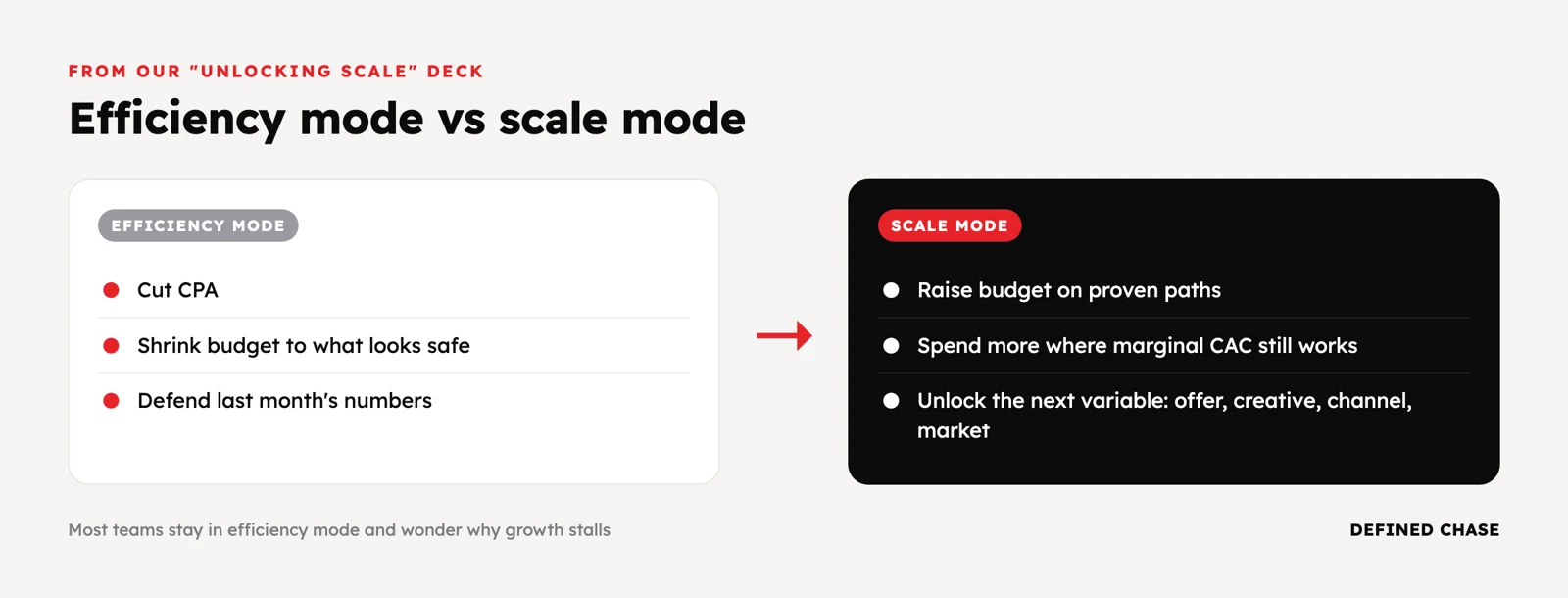
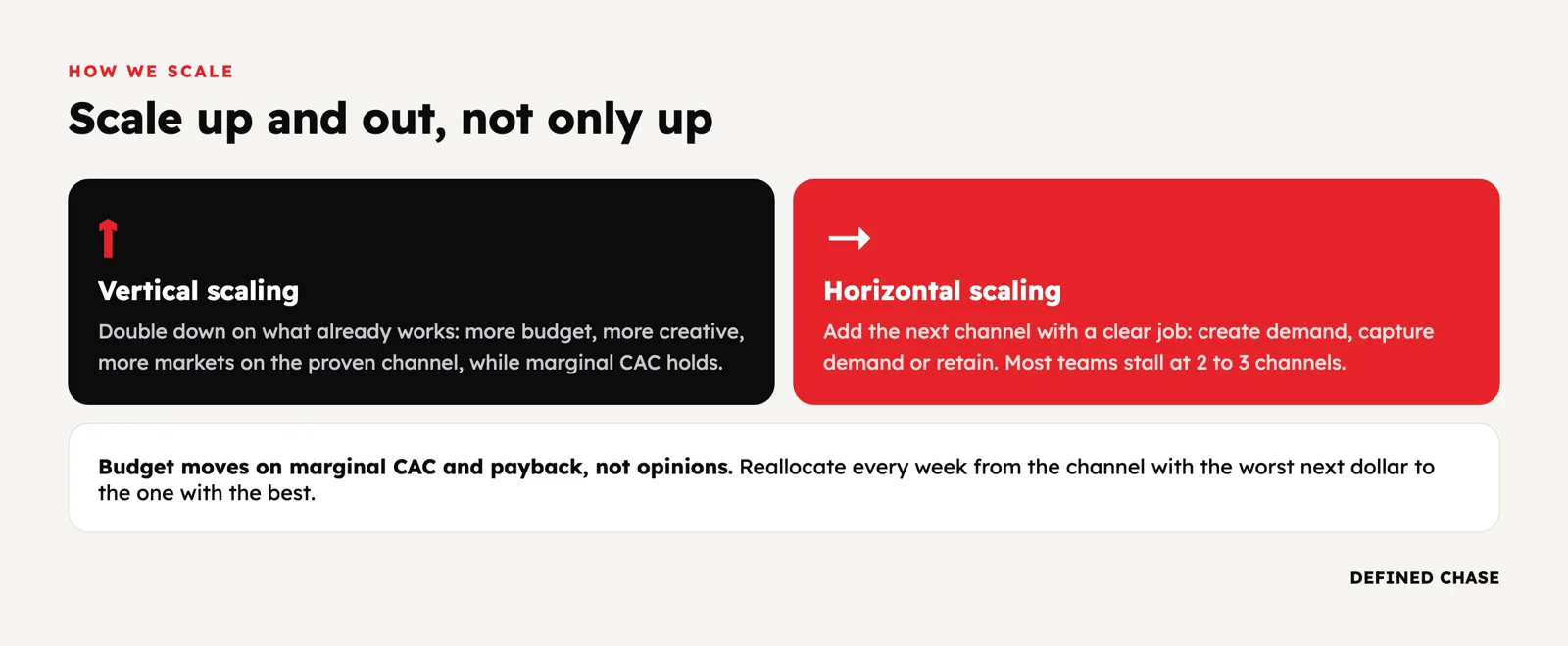
- Agree the gate before the money. Write down the marginal CAC or payback period that the next step has to hit, and where it will be measured: your orders, CRM or billing, not just the ad platform.
- Raise in steps, then hold. Increase budget, hold long enough to read a full conversion cycle, then decide. Steady steps beat big jumps you have to undo.
- Bring new creative with every step. More budget on the same ads mostly buys more frequency.
- Send the platforms better signals. Optimize to paying customers, qualified pipeline or value, and feed refunds and offline sales back where you can.
- Open the next channel when the current one bends. When marginal CAC on your main channel crosses the target, the next dollar is usually better spent testing somewhere new.
Common mistakes
- Judging scale on average CAC instead of what the last budget step bought.
- Raising budgets because ROAS looked good last week, without a written rule.
- Cutting a channel because its platform CPA rose, when tracking was the problem.
- Treating rising CAC as a media buying problem when the offer or landing page is the constraint.
- Counting returning customers and brand demand as new paid customers.
How we run it at Defined Chase
We work with brands spending $100,000 or more a month that want to spend more, profitably. Our order is always the same: make the numbers trustworthy, make the economics scalable, then increase spend only when an agreed Scale Gate holds on the client’s own data. Rising CAC comes up constantly on our growth strategy calls, and it is often tied to the complaint we hear most: tracking people cannot trust.
A public example: Tinggly came to us with a falling ROAS. After we rebuilt their Google Ads account around cleaner tracking and intent-based structure, their Chief Growth Officer wrote in a verified Clutch review that CPA fell from $105 to $84 and ROAS rose from 1.5 to 2.5 in the first three months. More in our case studies.
See how we work, or book a free 90-Day Growth Map Call to find the one constraint that makes your next budget step expensive.
FAQ
Is it normal for CAC to rise when you scale ads?
Yes, some rise is normal because each extra dollar reaches less ready buyers. What is not normal is CAC rising faster than customer value, or rising because of fixable problems like weak tracking, tired creative or a page that only converts warm traffic.
How do you calculate customer acquisition cost?
Divide acquisition spend by the number of new paying customers in the same period. For scaling decisions, also calculate marginal CAC: the extra spend between two budget levels divided by the extra customers it brought.
What is a good LTV to CAC ratio?
A commonly cited rule of thumb is 3 to 1. In practice, payback period matters as much: a 3 to 1 ratio that takes three years to pay back can still strain cash. Set the target from your margins and how fast you need the money back.
How fast can I increase my Meta ads budget?
There is no fixed safe percentage. Increase in steps your account can absorb without restarting learning, hold each step long enough to see real sales, and keep going only while marginal CAC stays inside the gate.
What is the difference between blended CAC and paid CAC?
Blended CAC divides all marketing spend by all new customers, including organic and referral. Paid CAC looks only at paid media and the customers it brought. Blended CAC can look healthy while paid CAC is getting too expensive.
Updated 16 October 2026.
Want to scale your ad spend?
On a free Growth Map Call we find what is capping your ad spend and the next 1 to 3 steps.
Attend a Growth Map CallRelated articles
PPC Management Pricing at $100K+ a Month: What a Paid Media Agency Costs
Short answer: paid media agencies charge in five ways: a percentage of ad spend, a flat monthly retainer, a hybrid of the…
Oct 16, 2026 · 8 min readMaximizing ROI on Your E-Commerce Website: Simple Tips and Tricks
Discover simple tips and tricks to maximize the return on investment (ROI) on your e-commerce website. Boost your online sales with these…
Jun 7, 2024 · 19 min readExpert Techniques for Optimizing Digital Campaign Performance
Discover expert techniques to optimize the performance of your digital campaigns. Maximize your ROI and achieve better results with these strategies.
Jun 2, 2024 · 9 min read