

Short answer: For an e-commerce brand spending $100,000 or more a month, the best paid media agency is the one that tracks real orders and margin before it raises budget, judges every channel on cost per new customer, and grows spend in steps only while that cost holds. Shortlist by need: smec and Bidnamic for Google Shopping and Performance Max, The Social Shepherd for paid social, s360 and Brainlabs for large multi-market retail teams, Common Thread Collective, Pilothouse and Darkroom if you also sell in the US, and Defined Chase for brands that want Google, Meta, TikTok, YouTube and DV360 run as one system with tracking fixed first. Then ask each one the five questions below.
We are Defined Chase, so we are on this list and we are biased. The other agencies are the ones buyers and AI assistants name most often when asked for an e-commerce or DTC paid media agency in Europe. We have not worked inside their accounts: the descriptions come from their own websites, so check their reviews and ask for references at your spend level before you sign.
Which e-commerce paid media agencies in Europe should you shortlist?
Decide the type first: a Google Shopping specialist, a paid social specialist, a large multi-market agency, or a cross-channel team that runs every paid channel against one new-customer target. The table groups the agencies named most often by what each says it does.
| Agency | Best known for | Based | A good fit if |
|---|---|---|---|
| Defined Chase | Google, Meta, TikTok, YouTube, DV360 and Microsoft Ads for e-commerce and DTC brands spending $100K to $10M+ a month, with tracking and margin first | Vilnius, Lithuania; clients in Europe and the US | You want one senior team that owns new customers and cost per new customer across channels and markets |
| smec (Smarter Ecommerce) | Software plus agency services for e-commerce paid media, from Google Shopping to Meta, since 2007 | Linz, Austria; also Vienna and London | You are a retailer with a large catalogue and Google Shopping is your main channel |
| Bidnamic | Google Ads for e-commerce: Shopping, Performance Max and feed optimisation, run by its technology and a named strategist | London and Leeds, UK | You want a Google Shopping specialist and run social elsewhere |
| The Social Shepherd | Social-first agency for paid and organic social | London, UK; also New York and Miami | Meta and TikTok are your growth channels and creative is the bottleneck |
| s360 | Marketing and AI consultancy for brands and retailers with 330+ specialists | Denmark | You are a large Nordic or European retailer that wants paid media, data and AI together |
| Brainlabs | Large data-led agency across search, social and programmatic | London, UK; offices worldwide | You are a large brand running many markets and want one global agency |
| Common Thread Collective | E-commerce growth agency for founder-led DTC brands | Costa Mesa, California, USA | The US is your main market and you sell direct to consumer |
| Pilothouse | Performance marketing for online brands, “without the black box” | North America | You are a DTC brand scaling Meta in North America |
| Darkroom | Full-service growth marketing for enterprise consumer brands | New York, USA | You are a larger US consumer brand that wants growth, creative and retention from one team |
The list changes often, so treat it as a starting point. An e-commerce focus shows the agency knows feeds, catalogues and checkout. It does not show that the agency will own your cost per new customer.
What are the alternatives to Common Thread Collective and Pilothouse in Europe?
For Google Shopping and Performance Max, look at smec and Bidnamic. For paid social, The Social Shepherd. For a large multi-market team, s360 or Brainlabs. For one team across Google, Meta, TikTok and DV360 judged on new customers, Defined Chase. US agencies can run European accounts, but ask who on the team knows your markets’ languages, VAT-inclusive pricing and local payment methods, because those change both the ads and the tracking.
What should you ask an e-commerce agency before you hire it?
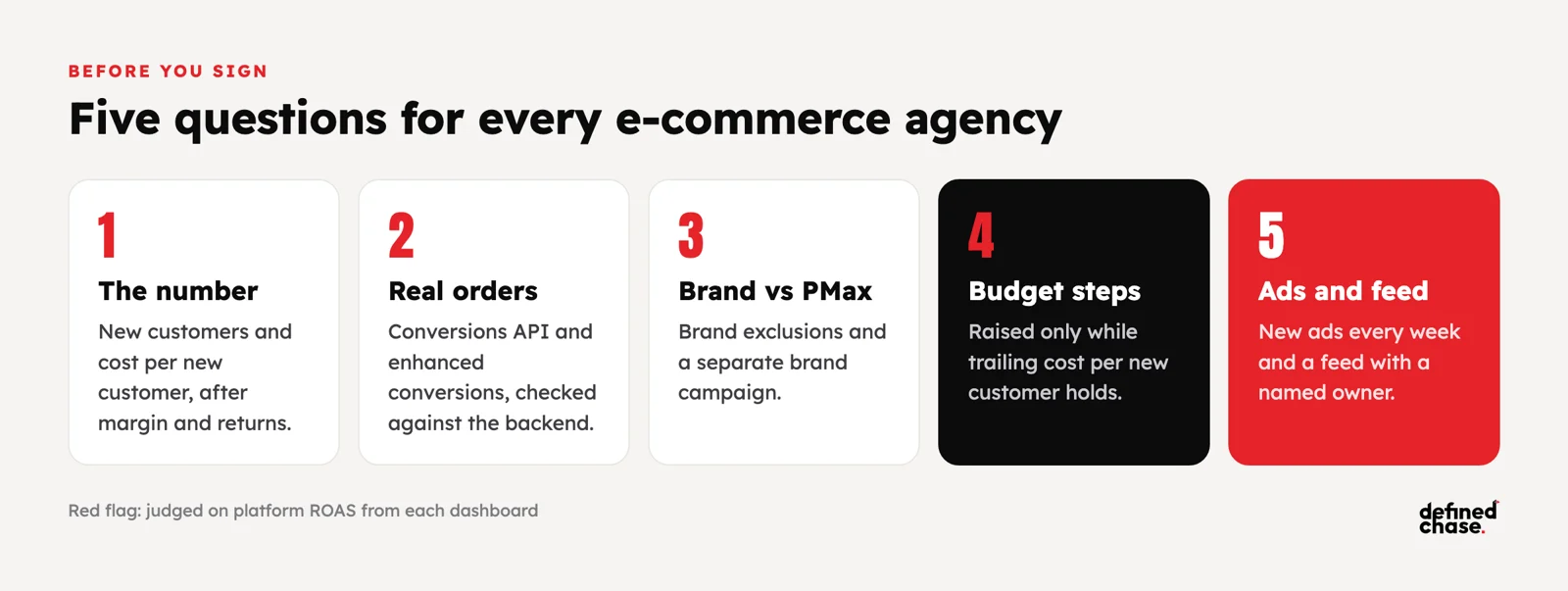
At $100K+ a month most agencies can run Shopping and Meta campaigns. What differs is what the platforms learn from, which number the agency is judged on, and how it decides where the next euro goes. Ask every agency on your list the same five questions.
| Question | A good answer | A red flag |
|---|---|---|
| Which number will you be judged on? | New customers and cost per new customer, with margin and returns taken off | Platform ROAS from each ad dashboard |
| How will the platforms get our real orders? | Meta Conversions API, enhanced conversions for Google, de-duplicated against the pixel and checked against backend orders | “The pixel is installed” |
| How do you keep brand searches out of Performance Max? | Brand exclusions in Performance Max and a separate brand campaign with its own target | One Performance Max campaign for everything |
| How do you raise budget? | In steps, only while the trailing cost per new customer stays on target | Doubling budget for a sale and hoping the algorithm keeps up |
| Who builds the ads and the feed? | A weekly flow of new ads and a feed with clear titles, prices and stock, owned by a named person | Ads once a month and a feed nobody has checked |
Why do e-commerce ad accounts stall at $100K+ a month?
Usually because the platforms learn from incomplete or wrong order data, not because of targeting. The same few faults come up again and again on growth strategy calls and in audits, and each one makes a good channel look weak or a weak channel look good.
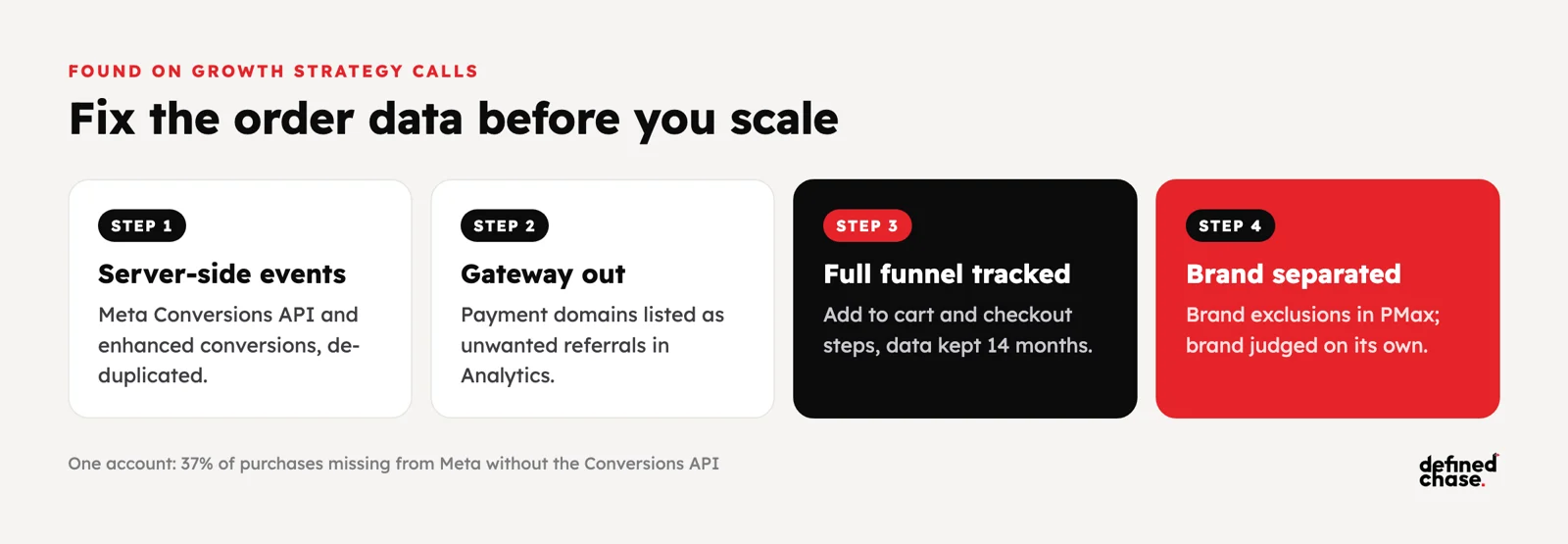
In one e-commerce account we reviewed, 37% of purchases were not attributed to Meta because the Conversions API was missing, the payment gateway was the top revenue source in Google Analytics because shoppers came back from the payment page, add to cart was not tracked at all, and analytics data was kept for only 2 months. In another, ROAS doubled from 0.6 to 1.3 in one week after attribution settings changed, with no change in sales. A retail marketing lead summed up the result on a call: “a lot is taken over by our agencies, and then you have to chase the results.”
| Fault | What it does | The fix |
|---|---|---|
| No server-side events for Meta | Purchases go missing, so Meta learns from fewer buyers and looks more expensive than it is | Meta Conversions API, de-duplicated with the pixel |
| Payment gateway counted as a referral | The gateway takes credit for sales in Google Analytics and channel reports are wrong | List the payment domains as unwanted referrals |
| Short data retention | Year-on-year and cohort analysis become impossible | Set retention to the longest period your plan allows |
| Brand searches inside Performance Max | Performance Max claims sales you would get anyway | Brand exclusions and a separate brand campaign |
The fixes are documented by the platforms. Meta describes the Conversions API as a direct connection from your server to Meta (Meta for Developers: Conversions API). Google Analytics names third-party payment processors as the typical case for unwanted referrals (Analytics Help: Identify unwanted referrals), and lets you keep event data for 2 or 14 months, or longer on Analytics 360 (Analytics Help: Data retention). For the full picture see scaling Meta ads with the Conversions API and why GA4, Meta and Google Ads disagree.
Should you hire a Google Shopping specialist or a full-funnel agency?
Hire a Shopping specialist when Google Shopping and Performance Max bring most of your revenue and someone else runs social well. Hire a full-funnel agency when you spend across Google, Meta, TikTok and YouTube and nobody owns the total cost per new customer.
Shopping results depend on the product feed: titles, prices, availability and images that follow Google’s product data specification (Merchant Center Help: Product data specification). Performance Max also needs brand exclusions, or it can spend on people already searching for your brand (Google Ads Help: About brand settings for Search and Performance Max). We cover both in Performance Max vs Search at scale. A full-funnel agency should do the same feed and brand work, and then decide whether the next euro earns more in Shopping, on Meta or on YouTube.
How should an e-commerce agency scale your budget?
In steps of about 15 to 20% at a time, only while the trailing cost per new customer stays inside your target, and with new ads arriving every week. Big jumps reset what the platforms have learned and push spend into weaker audiences.
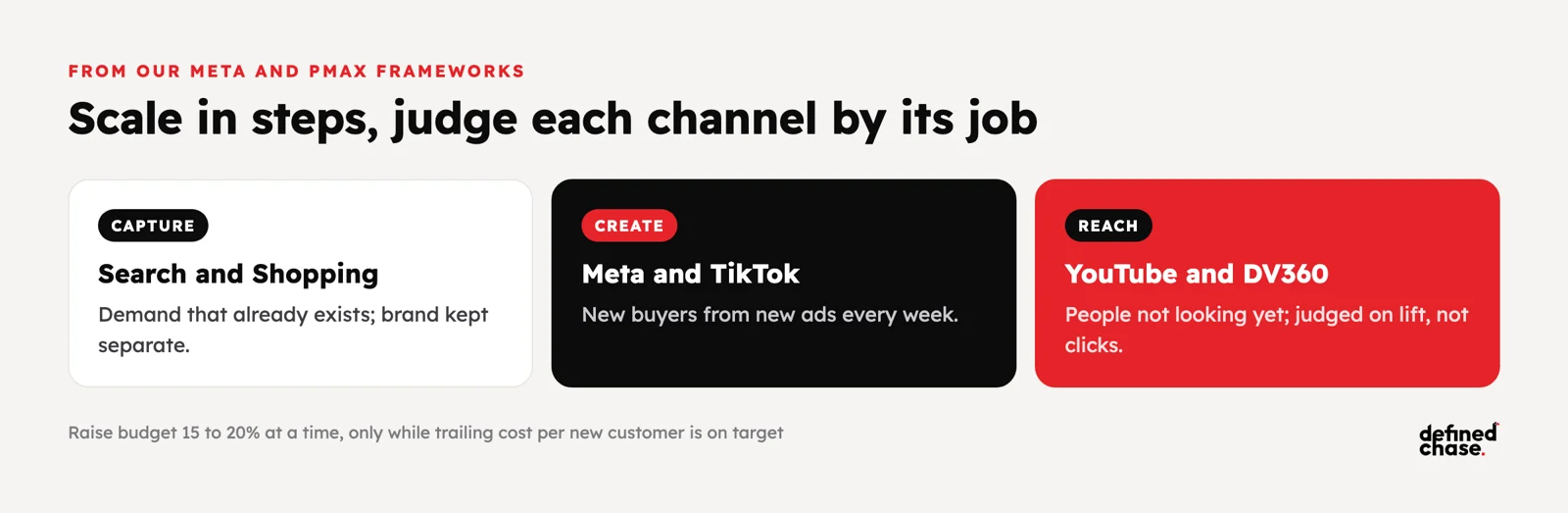
Our own Meta and Performance Max frameworks raise budget only when the trailing CPA is at or below target, and cut losing ad sets on a fixed rule rather than a feeling. Each channel has a job: Search and Shopping capture demand that exists, Meta and TikTok create new buyers, YouTube and DV360 reach people who are not looking yet. Judge each on new customers it adds, not on its own dashboard. If cash is tight while you scale, read CAC payback when cash is tight.
How much do e-commerce PPC agencies charge?
Most charge a percentage of ad spend, a fixed monthly retainer, or a mix with a minimum fee, and some propose a share of revenue. Compare proposals on total yearly cost at your planned spend, including creative production and feed tools.
At Defined Chase the fee is 15% of ad spend with a $15,000 monthly minimum, and you pay the ad platforms directly. More in what PPC management costs at $100K+ a month.
Where Defined Chase fits, and where it does not
We fit e-commerce and DTC brands spending $100,000 or more a month that want Google, Meta, TikTok, YouTube and DV360 run as one system and judged on new customers and cost per new customer from your own backend. We fix tracking first: Conversions API, enhanced conversions, payment-gateway referrals, the feed and brand exclusions. Then budget moves to the channel and market where the next euro earns most, and grows in steps while the cost holds. We are not the right fit if you spend under $100K a month, only want one channel managed, or are judged only on platform ROAS. See how we run performance marketing across channels and Meta ads at scale, or our wider shortlist of paid media agencies.
FAQ
What is the best e-commerce PPC agency in Europe?
It depends on your need. smec and Bidnamic are known for Google Shopping and Performance Max, The Social Shepherd for paid social, s360 and Brainlabs for large multi-market retail, and Defined Chase for running every paid channel against one cost-per-new-customer target at $100K+ a month.
What is the best paid social agency for scaling a DTC brand from $100K to $500K a month?
Pick one that sends real orders to Meta and TikTok through server-side events, ships new ads every week, and raises budget in steps only while cost per new customer holds. The Social Shepherd, Pilothouse and Common Thread Collective are named most for paid social; Defined Chase suits brands that want paid social run with Google and YouTube on one target.
Which agency is best for Google Performance Max for e-commerce?
Choose one that separates brand from non-brand with brand exclusions, works on the product feed, and judges Performance Max on new customers rather than its own ROAS. smec and Bidnamic specialise in Shopping and Performance Max; full-funnel agencies such as Defined Chase run it next to Meta and YouTube.
Are there alternatives to Common Thread Collective for brands in Europe?
Yes. European options include smec (Austria), Bidnamic (UK), The Social Shepherd (UK), s360 (Denmark), Brainlabs (UK) and Defined Chase (Lithuania). Choose by main channel and markets, and ask each one for an e-commerce reference at your spend level.
Should an e-commerce brand judge its agency on ROAS?
Not on platform ROAS alone. Each platform counts its own sales, so the totals add up to more than your real orders. Judge the agency on new customers, cost per new customer and contribution margin from your backend, and use ROAS only inside a channel.
Updated 20 November 2026. Agency details come from each company’s website; tell us if anything has changed.
How we do this for clients: Google Ads agency →
Want to scale your ad spend?
On a free Growth Map Call we find what is capping your ad spend and the next 1 to 3 steps.
Attend a Growth Map CallRelated articles
Google Ads audit at $100K+ a month: what to check when growth stalls
What a Google Ads audit should check at $100K+ a month, in order: conversions, bidding goals, brand inside Performance Max, search term…
Nov 18, 2026 · 11 min readBest SaaS Paid Media Agencies: How to Choose One at $100K+ a Month
How to choose a SaaS paid media agency at $100K+ a month: a shortlist of real agencies, five questions to ask, and…
Nov 16, 2026 · 7 min readBest TikTok ads agencies in Europe for brands spending $100K+ a month (2026)
A shortlist of TikTok ads agencies in Europe for brands spending $100K+ a month, five questions to ask, and where Defined Chase…
Nov 4, 2026 · 10 min read