
Short answer: GA4, Meta and Google Ads disagree because each one counts a different thing. Meta credits itself for conversions up to 7 days after a click or 1 day after a view, Google Ads reports conversions on the date of the ad click and adds modeled conversions, and GA4 shares one sale across all channels with a 90-day lookback. None of them sees every sale, because consent choices, Safari and iOS remove part of the data. At $100,000 or more a month, do not pick one platform as the truth. Use your backend orders or CRM as the source of truth, use the platforms to optimise inside each channel, and move budget between channels on reconciliation and incrementality tests.
This guide is for brands spending $100,000 or more a month across Google, Meta and other channels whose dashboards add up to more sales than the business made. It covers why the numbers differ, which attribution model to use, which measurement method answers which question, and the weekly routine that turns three conflicting reports into one number a CEO can trust. For the tracking setup itself (server-side tagging, Conversions API, offline imports), see our guide to server-side tracking before you scale.
What we hear about attribution on growth strategy calls
Tracking you cannot trust is the most common pain on our growth strategy calls, ahead of the scale ceiling and agency trust. The wording changes, the problem does not:
- “Setting up attribution, tracking. This has been an issue for us for years and years.”
- “The Google numbers and the back-end data is not matching, so what’s working good in Google actually is not working in the back-end.”
- “That attribution takes sales that don’t exist. Daily sales are not six or nine thousand, but sometimes four thousand.” (translated)
- “The campaign numbers seem to grow, but actual revenue and bookings have not grown as much as the extra money spent.” (translated)
Quotes are anonymous and shortened. The pattern behind all four: each platform is graded on its own report, so every platform looks like it is working, and nobody can say what the last budget step bought.
Why do GA4, Meta and Google Ads show different numbers?
They show different numbers because they use different attribution windows, different credit rules, different dates and different data. A gap between them is normal; a gap you cannot explain is the problem.
| Source | What it counts | Why it differs |
|---|---|---|
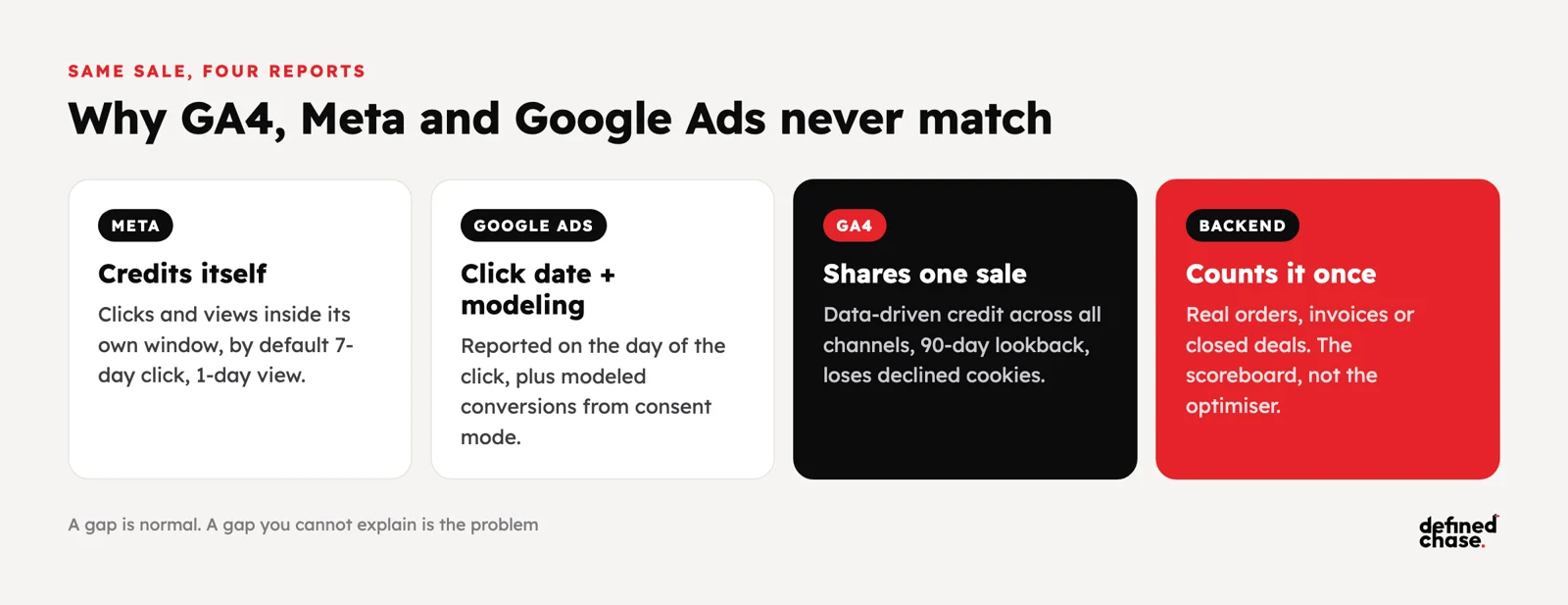
| Meta Ads Manager | Conversions after a click or a view of a Meta ad, by default within 7 days of a click or 1 day of a view | Credits itself for view-through sales that other tools never see, and does not know about the Google click that came later |
| Google Ads | Conversions after a Google ad click, reported on the date of the click, including modeled conversions | A sale today can appear under last week’s click; consent mode modeling fills in users who declined cookies |
| GA4 | Key events credited across all channels with data-driven or last-click attribution | Only one channel gets each conversion’s credit, so paid channels get less than they claim; it loses users who reject cookies |
| Backend or CRM | Real orders, paid invoices or closed deals | The only source that counts each sale once, but it does not know which ad caused it |
Google documents the date rule directly: the standard “Conversions” column reports conversions by the time of the ad click, and Google suggests “All conv. (by conv. time)” when comparing with your own systems (Google Ads Help: understand your conversion tracking data). Modeled conversions from consent mode appear in the same “Conversions” column (Google Ads Help: consent mode modeling). In GA4, the default lookback window for most key events is 90 days, and 30 days for first visits and first opens (Analytics Help: attribution settings).
Why the platforms add up to more sales than you made
When a buyer sees a Meta ad, clicks a Google ad two days later and then buys, Meta and Google both count the sale in full. GA4 gives it to one of them. Add these overlaps up across channels and the platform total can sit well above real orders, which is what the illustrative example below shows.
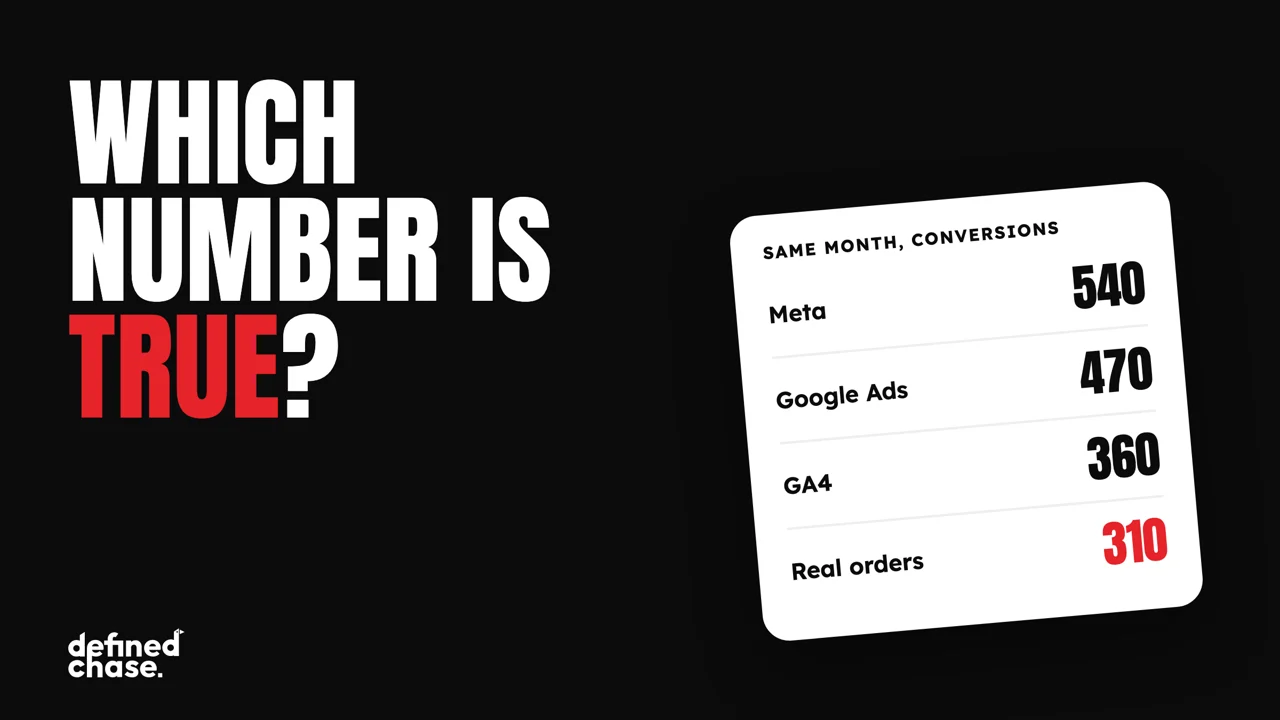
| Same month, same store | Conversions reported | Gap vs real orders |
|---|---|---|
| Meta Ads Manager | 540 | +74% |
| Google Ads | 470 | +52% |
| Meta + Google combined | 1,010 | +226% |
| GA4 (all channels, paid and organic) | 360 | +16% |
| Backend orders | 310 | source of truth |
Illustrative numbers, not a client result.
Why every tool also misses sales
Over-counting and under-counting happen at the same time. Safari’s tracking prevention deletes cookies set by JavaScript after 7 days without a visit (WebKit tracking prevention), App Tracking Transparency lets iOS users refuse cross-app tracking (Apple: user privacy and data use), and in Europe tags must wait for consent. On calls we regularly see pixel-only setups miss a large share of conversions, in some accounts more than a third, and paid app installs land in “organic” because the user declined tracking. That is why a server-side signal (Meta Conversions API, enhanced conversions, offline imports) matters before any attribution debate.
Which attribution model should you use?
Use data-driven attribution in GA4 and Google Ads as the default, and keep last click as a cross-check. The rule-based models most teams argued about are gone: Google retired first click, linear, time decay and position-based attribution in November 2023.
GA4 now offers three models: data-driven, paid and organic last click, and Google paid channels last click (Analytics Help: get started with attribution). Google Ads moved conversion actions that used the retired models to data-driven attribution, and last click is still available (Google Ads Help: about attribution models).
| Model | Use it for | Do not use it for |
|---|---|---|
| Data-driven (GA4, Google Ads) | Day-to-day reporting and bidding inside Google; sharing credit across touchpoints | Proving that a channel caused sales it was credited with |
| Last click | A stable cross-check and spotting which channel closes | Judging prospecting, video or social, which it undervalues |
| Platform default (Meta, TikTok, LinkedIn) | Optimising campaigns and creative inside that platform | Comparing channels against each other |
The model choice matters less than most teams think. No attribution model tells you what would have happened without the ad. That question needs a test.
Which measurement method answers which question?
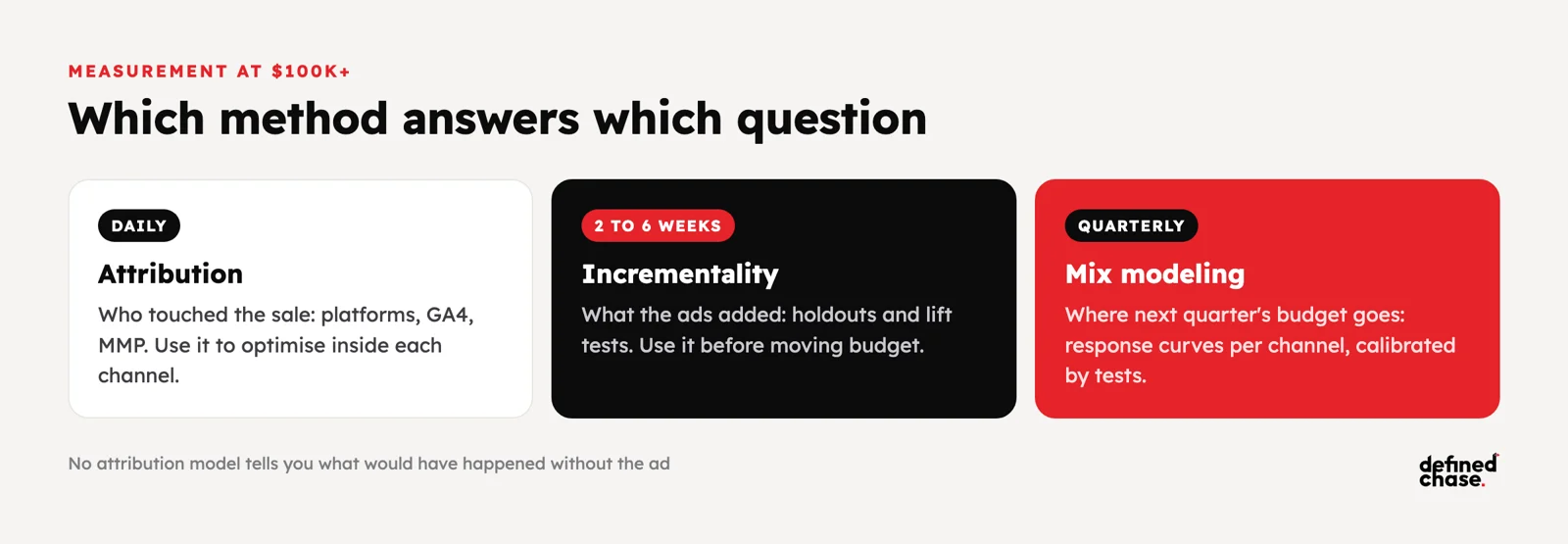
Attribution answers “who touched the sale”, incrementality answers “what did the ads add”, and marketing mix modeling answers “where should next quarter’s budget go”. At $100,000 or more a month you need all three, at different speeds.
| Method | Question it answers | Speed | Watch out for |
|---|---|---|---|
| Platform reporting | Which campaign, ad set and creative to scale or cut | Daily | Self-credit; never compare platforms on it |
| GA4 | How channels share credit across the whole site | Daily | Consent and cookie loss; payment gateways stealing credit as a “referral” |
| Mobile measurement partner (AppsFlyer, Adjust, Singular) | Which network brought the install and the revenue event, for apps | Daily | Needs revenue events, not installs, sent back to networks |
| Multi-touch attribution tools | One de-duplicated view of paid touchpoints, often for e-commerce | Daily to weekly | Still correlation; check it against the backend |
| Incrementality tests (geo holdouts, conversion lift) | What a channel adds that would not happen anyway | 2 to 6 weeks per test | Needs enough volume and a clean holdout |
| Marketing mix modeling (Robyn, Meridian) | How each channel’s return changes with spend, and the best budget split | Monthly to quarterly | Needs 2+ years of weekly data and calibration with tests |
Our incrementality and marketing mix modeling guide covers how to run the tests and when a model is worth building.
How do you set one source of truth?
Make the backend the scoreboard, let each platform optimise on its own data, and reconcile the two every week. Four steps:
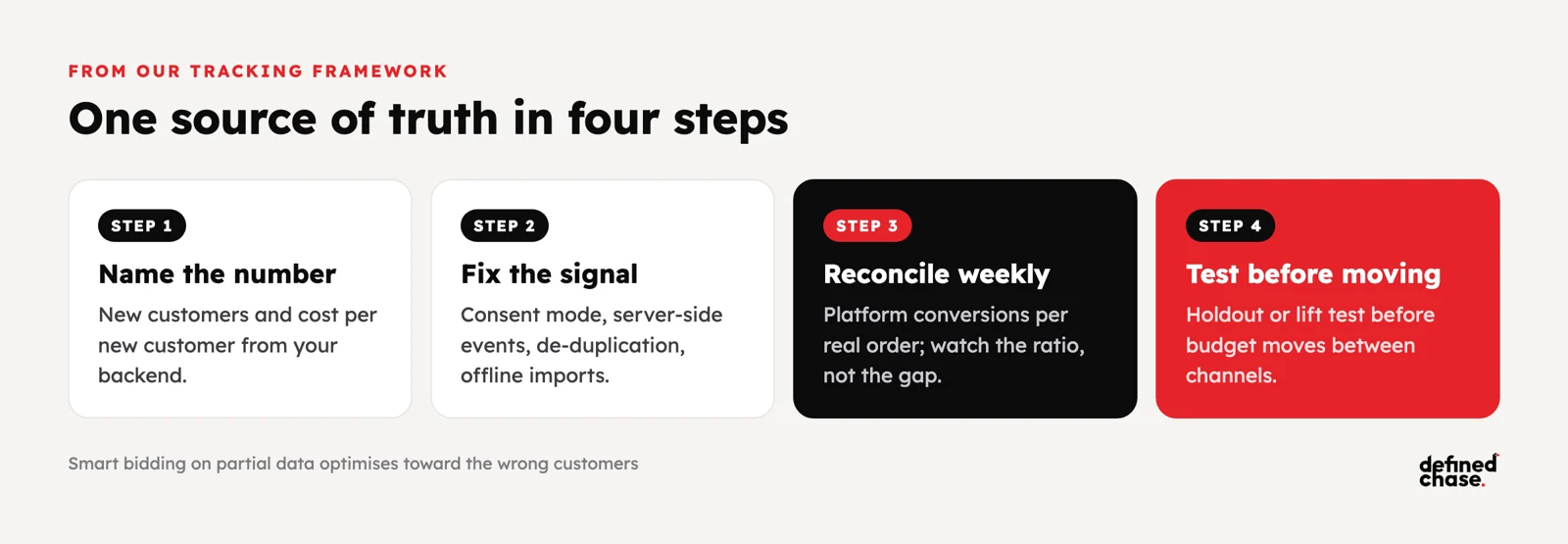
- Name the number. New customers and cost per new customer from your orders, billing or CRM, not platform ROAS. This is the number on the weekly CEO marketing report.
- Fix the signal. Consent mode wired to a real consent banner, tags that respect consent, server-side events with de-duplication, and real sales or qualified pipeline sent back through the Conversions API and offline imports. Smart bidding on partial data optimises toward the wrong customers.
- Reconcile weekly. Compare each platform’s conversions with backend orders. Track the ratio, not the absolute gap: if Meta usually reports 1.6 conversions per real order and that jumps to 2.4, something broke or changed.
- Move budget on tests, not reports. Before you move a large share of budget between channels, run a holdout or lift test, and use the result to calibrate the platform numbers.
What are the most common attribution mistakes at scale?
The most common mistake is adding up platform-reported conversions and treating the total as revenue. The others are close behind:
- Cutting a channel because its last-click numbers look weak, when it feeds the channels that close.
- Letting payment gateways, a redirect without “www” or a missing UTM on a brand campaign push paid sales into “referral”, “direct” or “organic” in GA4.
- Sending installs, add-to-carts or raw form fills as the optimisation event instead of revenue or qualified pipeline.
- Switching attribution model or window mid-quarter and comparing the new numbers with the old ones.
- Buying an attribution tool before the basic events, consent and de-duplication are correct.
How we run it at Defined Chase
We work with brands spending $100,000 or more a month that want to spend more, profitably. Tracking comes first in every engagement: we audit consent, GTM, GA4, server-side events and offline imports, fix what breaks the signal, and then agree one scoreboard from the client’s own backend before any budget increase. Each platform still optimises on its own data, and we reconcile it against real orders every week, with holdout or lift tests when budget moves between channels. See how we run server-side tracking and measurement, or book a free 90-Day Growth Map Call to find out which of your numbers to trust before the next budget step.
FAQ
Why are my GA4 conversions lower than Google Ads?
Google Ads counts conversions after its own ad clicks, on the date of the click, and includes modeled conversions for users who declined cookies. GA4 shares each conversion across all channels, so Google Ads gets only part of the credit, and GA4 loses users who reject analytics cookies. A gap is normal; check the trend of the ratio.
Why does Meta report more conversions than my store?
Meta counts conversions within its attribution window, including view-through conversions, and other channels claim many of the same sales. Without the Conversions API and event de-duplication it can also double count. Compare Meta’s number with backend orders every week and watch the ratio.
What is the best attribution model in 2026?
Data-driven attribution is the default in GA4 and Google Ads and is the best choice for daily reporting. First click, linear, time decay and position-based models were retired in November 2023. For budget decisions between channels, use incrementality tests and marketing mix modeling, not any attribution model.
Do I need a multi-touch attribution tool?
Only after consent, tracking and de-duplication are correct and you spend across several channels. A tool helps de-duplicate paid touchpoints, but it is still correlation, so calibrate it with lift tests and your backend.
What is the difference between attribution and incrementality?
Attribution shares credit for a sale among the touchpoints before it. Incrementality measures how many sales the ads added that would not have happened anyway, usually with a holdout group that does not see the ads.
Updated 6 November 2026.
How we do this for clients: Server-side tracking and GA4 →
Want to scale your ad spend?
On a free Growth Map Call we find what is capping your ad spend and the next 1 to 3 steps.
Attend a Growth Map CallRelated articles
DV360 Brand Lift: How to Measure Awareness Against Blended CPA
How to run a DV360 or YouTube Brand Lift study that gives a readable answer, and tie lifted users, branded search and…
Oct 28, 2026 · 9 min readIncrementality and Marketing Mix Modeling: A Practical Guide at $100K+
How to measure what your ads really add at $100K+ a month: attribution vs incrementality vs MMM, geo holdouts, conversion lift, brand…
Oct 22, 2026 · 9 min readCEO marketing report: spend to payback on one page
What a monthly CEO marketing report should show at $100K+ a month: spend, revenue, new customers, CAC payback, LTV:CAC and one budget…
Oct 20, 2026 · 8 min read