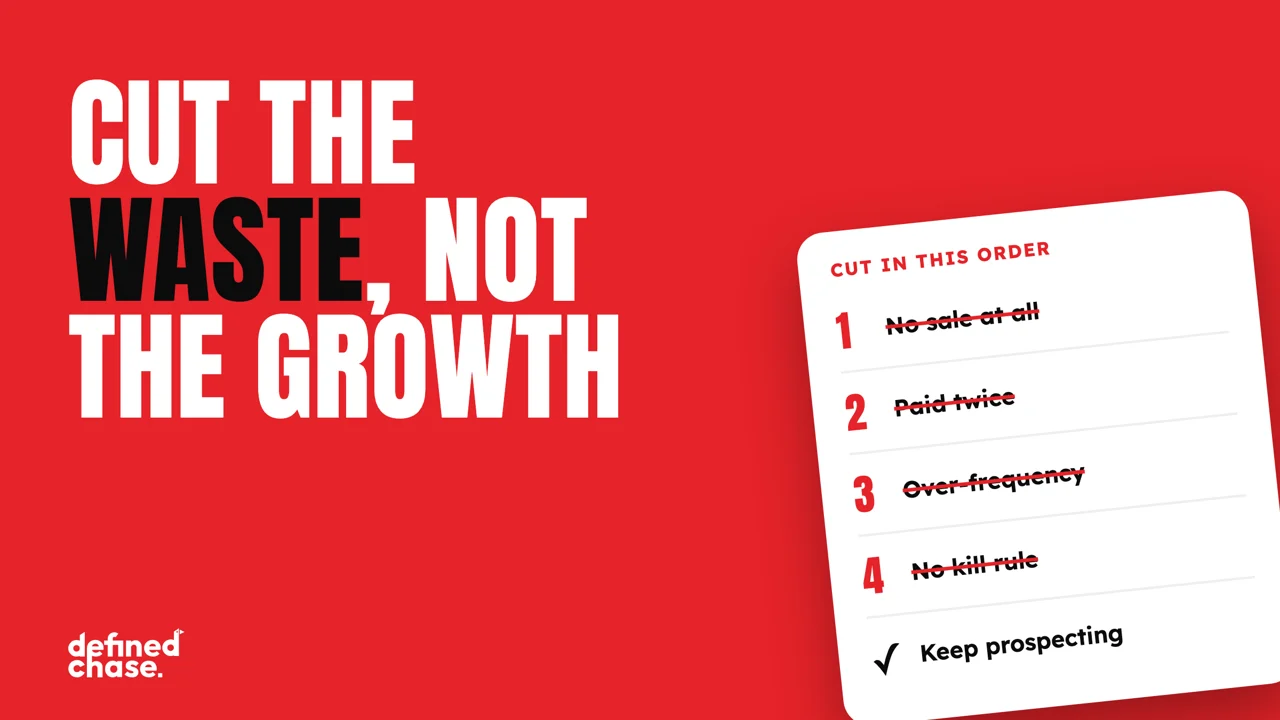
Short answer: When cash is tight, do not cut ad spend evenly across channels. Set one payback limit the cash can carry (for example, new customers must earn back their cost within 3 or 6 months of gross margin), then cut in a fixed order: spend with no sales at all, spend that buys the same customer twice (brand inside Performance Max, overlapping campaigns), remarketing past a sensible frequency, tests with no kill rule, and only then markets or products whose marginal cost per new customer is above the limit. Protect proven non-brand prospecting, tracking and a minimum creative refresh, because cutting those is what stops growth. Move money to the cheapest new customers before you reduce the total, and write down the number that turns spend back on.
This guide is for teams spending $100,000 or more a month whose budget has just been cut, frozen or put on a payback target by finance. It is not about why the cost of a customer goes up as you scale; that is in why customer acquisition cost rises when you scale. And it does not repeat the reporting side, which is in the one-page CEO marketing report. This one answers a narrower question: the cash is shorter than the plan, so what do you cut, what do you keep, and how do you know when to spend again?
What we hear about tight budgets on growth strategy calls
Cash pressure is rarer on growth strategy calls than tracking or scale problems, but when it comes up it decides everything else. It sounds like this:
- “Our budget has contracted now, so I don’t want to open a new market.”
- “Can we have the same amount of sales by reducing the budget, that’s my question?”
- “We are stuck because we cannot increase budgets, grow, increase those sales, because we don’t break even.”
- “We need to secure as much cash flow as possible for Black Friday and Christmas so we can spend money calmly.”
- “I don’t know what our customer acquisition cost is today, I don’t know what that payback is. So we’re a little bit blind.”
The last one is the real problem in most of them. A team that does not know its payback can only cut by feel, and cutting by feel usually means a flat percentage off every channel. That removes the good spend together with the waste, and next month the cost of a customer looks worse, not better.
Which CAC payback to use when cash is tight
CAC payback is the number of months a new customer needs to earn back what it cost to win them: cost per new customer divided by monthly gross margin per customer. The full calculation is in the CEO report guide. When cash is tight, the question changes from “is this customer worth it over its life?” to “how fast does this customer give the money back?”, so pick the version that matches the cash you actually have.
| Version | How to read it | Use it when |
|---|---|---|
| First-order payback | Margin on the first purchase covers the cost of winning the customer | E-commerce with low repeat rates, or cash needed back this month |
| Payback in months | Cost per new customer divided by monthly gross margin per customer | Subscriptions, SaaS, apps with recurring revenue |
| Cohort payback | Month in which a real cohort’s cumulative margin passes its acquisition cost | You have 6 to 12 months of clean cohorts and want the honest number |
| Marginal payback | Payback of the last part of the budget, not the average | Deciding which spend to cut first |
The average hides the decision. An account can pay back in four months on average while its last 20% of spend pays back in eleven. When finance says “cut 20%”, that last 20% is the part to look at, and it is usually not spread evenly across channels.
Cut in this order
The order matters more than the amount. Each step below removes spend that was not buying new customers, so the cost of a customer improves as the budget falls. The examples are real findings from accounts we audited, without names.
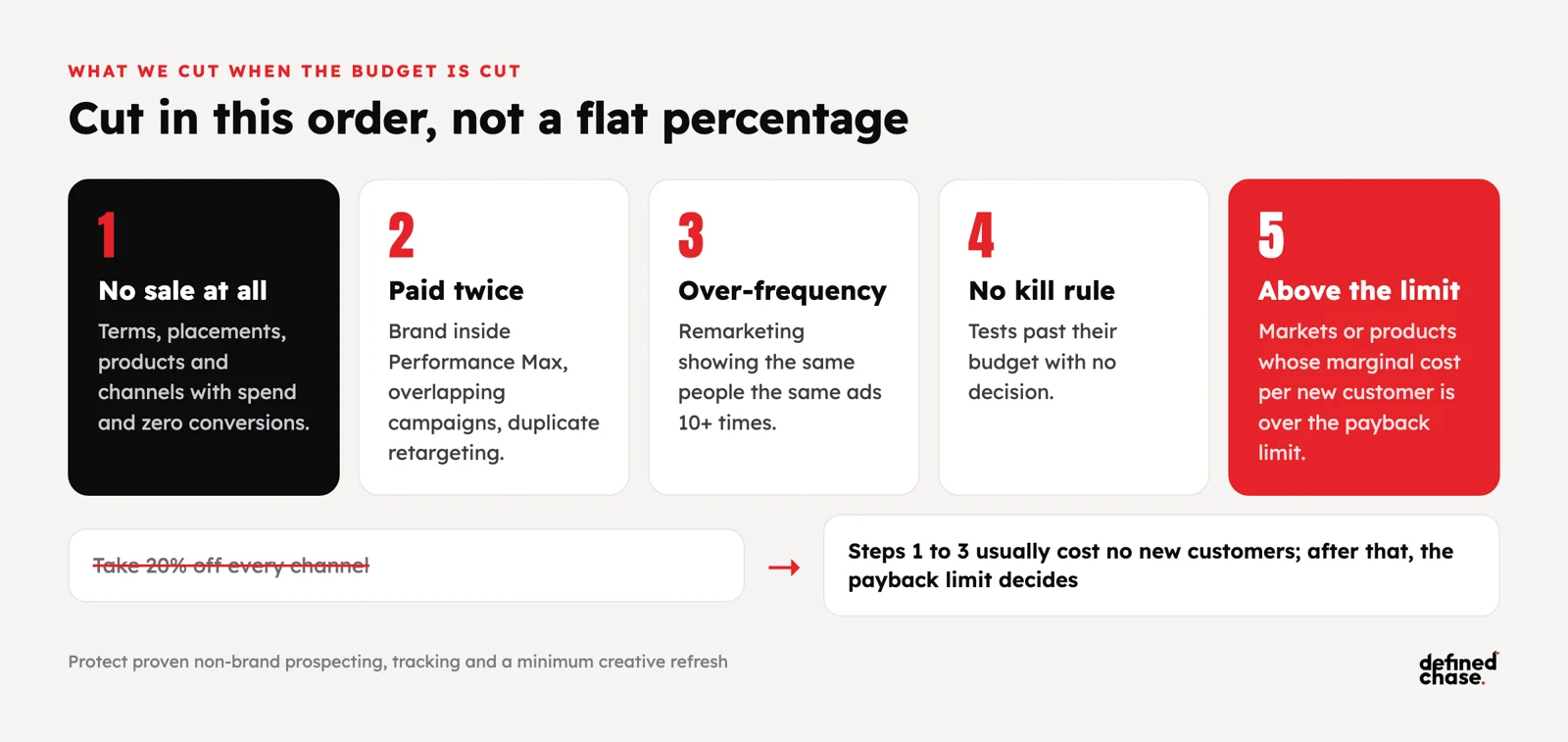
| Order | What to cut | What it looks like in audits |
|---|---|---|
| 1. No sale at all | Search terms, placements, products and channels with spend and zero conversions over a fair window | 455 keywords with no conversions in one grocery account; 43,400 catalog products with no sales taking 6% of the budget; a Demand Gen test at 3,500 EUR with no conversions; ads served to children in mobile games |
| 2. Buying the same customer twice | Brand terms inside Performance Max, overlapping campaigns, duplicate retargeting across channels | Performance Max taking brand searches without exclusions; a page feed campaign taking search terms from the main campaigns; products in two campaigns bidding against each other |
| 3. Remarketing past its frequency | Retargeting that shows the same people the same ads 10 or more times | Retargeting frequency rising from 11 to 14; one account with 85% of budget on remarketing and 16% on finding new buyers |
| 4. Tests without a kill rule | New channels, markets and campaigns that have run past their budget with no decision | New campaigns holding 47.8% of spend at 19.35 EUR an order against 9.54 EUR for the proven ones |
| 5. Above the payback limit | Markets, products or audiences whose marginal cost per new customer is above the limit finance set | A city with high cost and no conversions excluded; budget moved to the region with the better return |
Most accounts we look at can take a real cut from steps 1 to 3 alone without losing a single new customer. That is why the question “can we have the same sales on a smaller budget?” often has the answer yes, once. After the waste is gone, every further cut costs customers, and the payback limit decides which ones.
What not to cut
Three lines look like savings and turn into a slower, more expensive account a month later:
- Proven non-brand prospecting. It is the only spend that finds customers you do not already have. Cut it and remarketing, brand and email shrink a few weeks later because nobody new enters the funnel. On one account where prospecting had fallen to 16%, the team’s own words were “remarketing starts burning itself out.”
- Tracking and conversion data. Server-side tracking, offline conversions and correct conversion goals are what let the platforms find cheaper buyers. Switching them off to save a fee makes every remaining euro less efficient.
- A minimum creative refresh. On Meta and TikTok, fatigue raises costs within weeks. Keep a small, steady flow of new ads on the campaigns you keep, even if you stop testing new angles.
Brand search is a special case. Keep it bid for impression share with a cap, not cut to zero, because competitors will take the searches. But test how much of it organic results absorb: one e-commerce account halved its brand budget as a test to see how many of those sales came in anyway.
Set a payback limit for each layer
One payback number for the whole account forces bad trades. Different spend layers pay back at different speeds, so give each layer its own window, agreed with finance before the cut, and judge each on its own line.
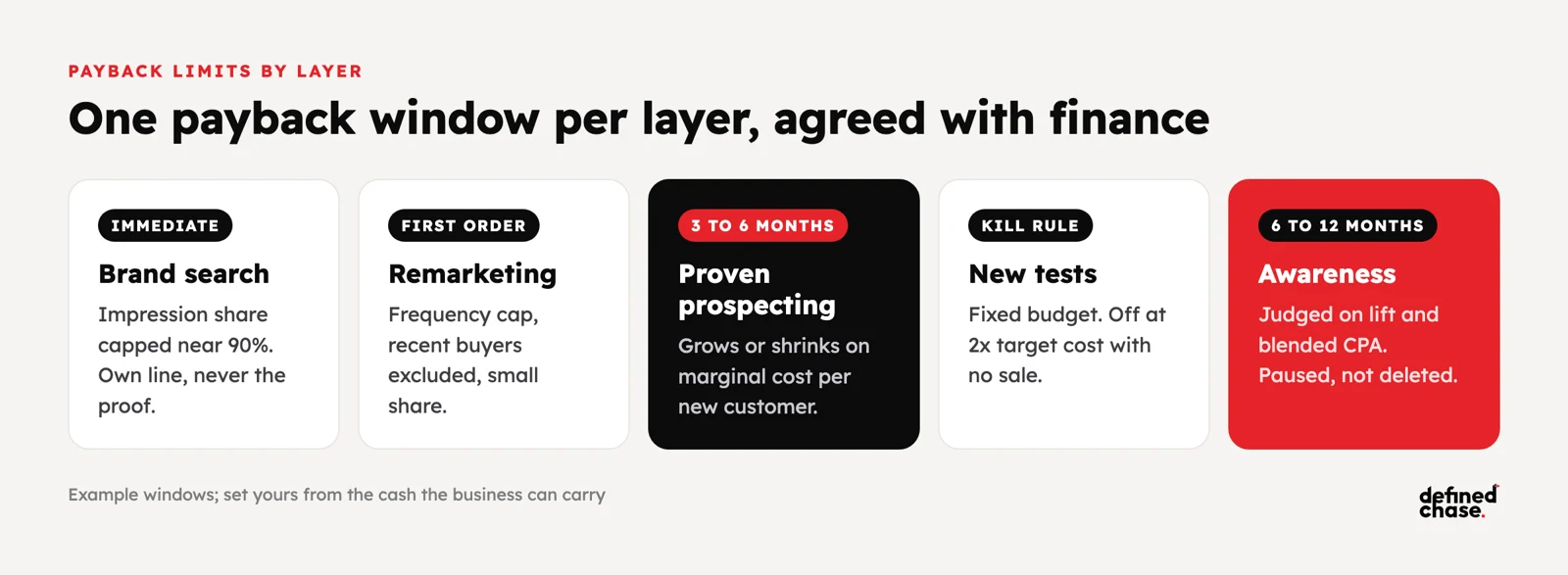
| Layer | Typical window when cash is tight | Rule |
|---|---|---|
| Brand search | Immediate | Impression share with a cap near 90%; reported separately, never used to prove the rest |
| Remarketing | First order | Frequency cap, exclusions for recent buyers, a small share of total spend |
| Proven non-brand prospecting | Within the limit finance set, for example 3 to 6 months | Grows or shrinks on marginal cost per new customer, one budget step at a time |
| New tests | Not judged on payback yet | A fixed test budget and a written kill rule, for example off at twice the target cost with no sale |
| Awareness | 6 to 12 months | Own line, judged on lift, branded search and blended CPA; paused, not deleted, if cash is very short |
Move money before you reduce the total
The fastest way to a better payback is often not a smaller budget but a different one. Our growth framework reallocates budget on marginal cost per customer and return, not on opinions, every week. In practice that means the last euro goes to the channel, market or product where the next new customer is cheapest, and comes out of the one where it is most expensive.
On one B2B SaaS account spending about 50,000 a month, three product lines were costing three to four times more per active client than the rest. About 10,000 a month moved to enterprise buyers with the total unchanged, and on that plan an extra 30,000 for the year was approved. The budget did not need a cut; it needed a better split, and a written split is what finance agreed to fund.
A 30-day plan when the budget is cut
- Week 1: get the real numbers. Cost per new customer from the backend, not the platforms, by channel and market. Gross margin per customer. The payback limit finance can carry, written down.
- Week 2: remove the waste. Steps 1 to 3 of the cut order: zero-conversion spend, brand and campaign overlap, remarketing past its frequency. Measure how many new customers were lost; usually none.
- Week 3: reallocate. Rank what is left by marginal cost per new customer. Move budget from the most expensive layers to the cheapest. Stop or pause tests that passed their kill rule.
- Week 4: set the gate to spend again. Agree the number that turns budget back on, for example trailing 4-week cost per new customer at or under the limit, and the step size, such as 15 to 20% at a time.
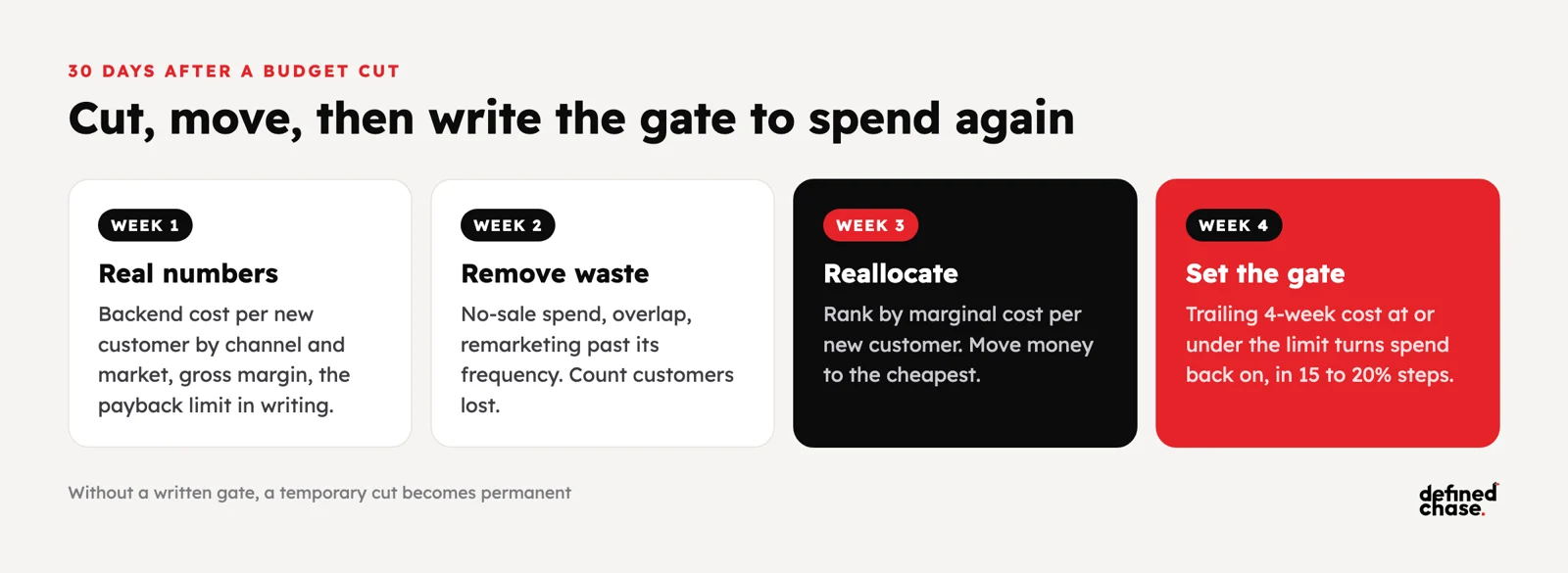
The fourth week is the one most teams skip. Without a written gate, the budget stays cut long after the cash is back, because nobody knows what “good enough to spend again” means.
Common mistakes
- A flat cut across every channel. It removes the best spend together with the worst and makes the average worse.
- Cutting prospecting and keeping remarketing. The return looks better for a month, then the funnel empties.
- Judging the cut on platform ROAS. Brand and remarketing look best in the platforms because they claim sales that would have happened anyway. Judge on new customers from your own data.
- Start, stop, start. Pausing campaigns completely and restarting them makes the platforms relearn and raises the cost. Lower budgets in steps instead.
- Opening a new market during a cut. New markets need test money and patience. Finish the reallocation first.
- No gate to restart. If the number that turns spend back on is not written down, the cut becomes permanent by default.
How we run it at Defined Chase
When a client’s budget is cut, we do not take a percentage off every line. In the first week we rebuild the cost per new customer from the backend and agree a payback limit with finance. Then we cut in the order above, show how many new customers each step cost (usually none for the first three), move the remaining money to the cheapest new customers, and write the gate that turns spend back on into the weekly scorecard. See how we run performance marketing for brands spending $100K+ a month, or book a free Growth Map Call to find out which part of your budget is buying no new customers.
FAQ
What is a good CAC payback period?
It depends on how much cash the business can tie up. Many subscription businesses accept 6 to 12 months; when cash is tight, finance often asks for 3 to 6, and e-commerce with few repeat purchases often needs the first order to pay back. Pick the limit the cash can carry, then judge each layer of spend against it.
How do you calculate CAC payback?
Divide the cost of winning a new customer by the monthly gross margin that customer brings. For example, a $120 cost per new customer and $30 of gross margin a month is a four-month payback. Use new customers from your own backend, not platform conversions.
What should you cut first when the marketing budget is reduced?
Spend with no sales at all, then spend that buys the same customer twice, such as brand searches inside Performance Max, then remarketing past a sensible frequency, then tests with no kill rule. Only after that cut markets or products whose marginal cost per new customer is above your payback limit.
Can you keep the same sales on a smaller ad budget?
Often yes, once, if the account has waste: zero-conversion terms, overlap between campaigns and remarketing that shows the same people too many ads. After that waste is removed, every further cut costs new customers.
Should you stop prospecting to save cash?
No. Proven non-brand prospecting is the only spend that brings in customers you do not already have. Cut it last and in steps; brand and remarketing shrink a few weeks after it does.
What is marginal CAC?
The cost of the last extra customers you bought, not the average. If $10,000 more spend brings 40 more customers, the marginal CAC is $250 even if the account average is $120. It shows which part of the budget to cut or move first.
When should you raise the budget again after a cut?
When the gate you wrote down holds, for example trailing 4-week cost per new customer at or under your payback limit. Raise it in steps of 15 to 20% and hold each level for a few weeks before the next.
Updated 29 October 2026.
How we do this for clients: Performance marketing for $100K+/month brands →
Want to scale your ad spend?
On a free Growth Map Call we find what is capping your ad spend and the next 1 to 3 steps.
Attend a Growth Map CallRelated articles
Best paid media agencies for brands spending $100K+ a month (2026)
Short answer: For a brand spending $100,000 or more a month on ads, the best paid media agency is the one that…
Oct 30, 2026 · 5 min readMarketing scorecard: one owner for the full number
Name one owner for spend, new customers, cost per new customer and payback, and run one weekly marketing scorecard. Template, budget rules…
Oct 19, 2026 · 7 min readAgency vs In-House Paid Media at $100K+ a Month: How to Decide
Short answer: at $100K+ a month, the choice is not really agency or in-house. It is whether one owner is accountable for…
Oct 17, 2026 · 11 min read