
Short answer: to scale mobile app user acquisition past $100,000 a month, stop judging channels on cost per install and judge them on cohort ROAS against a payback target: what each week’s users pay back by day 7, day 30 and later. Google App campaigns and Meta usually carry the base. TikTok adds reach with creative-led growth, AppLovin can scale strongly once you send it real revenue events, and Apple Ads captures high-intent iOS searches. Clean measurement through a mobile measurement partner (MMP), a steady creative pipeline and budget rules tied to cohort ROAS decide how far you can go.
This guide is for app teams in subscription, fintech, mobility, games and consumer apps that already spend on user acquisition and want to know what changes at six and seven figures a month. It is written from how we run app UA at Defined Chase.
What changes in app user acquisition past $100K a month?
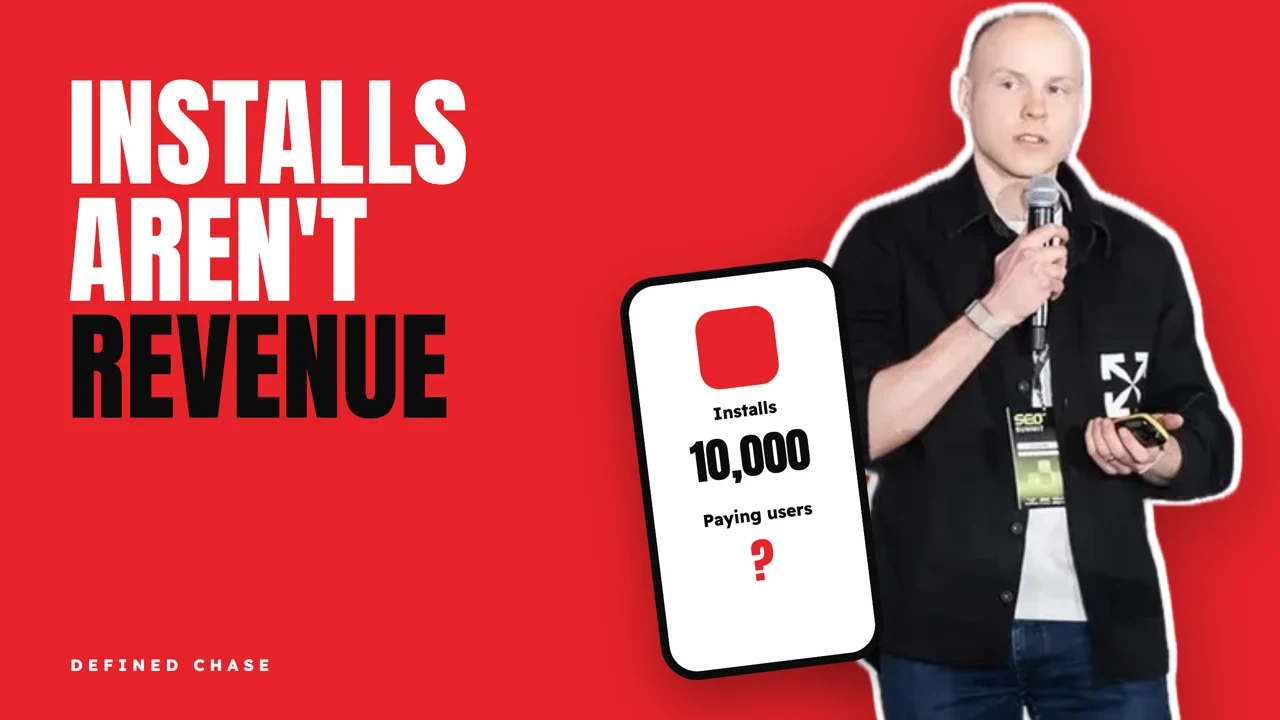
- Installs stop being the goal. At small budgets, cheap installs can look like progress. At scale, only paying, retained users matter, and they cost more.
- Cohorts become the language. You judge each week’s users by how much revenue they return over time, not by last week’s blended numbers.
- One channel cannot carry it all. Leaning on a single network hits a ceiling, and diversifying too early spreads budget too thin to learn.
- Creative volume decides the ceiling. Most app networks are now creative-led. The number of distinct concepts you test each week limits how far you can scale.
- iOS measurement gets harder. With App Tracking Transparency, most iOS performance is read through SKAdNetwork or AdAttributionKit postbacks, modeled data and your own backend.
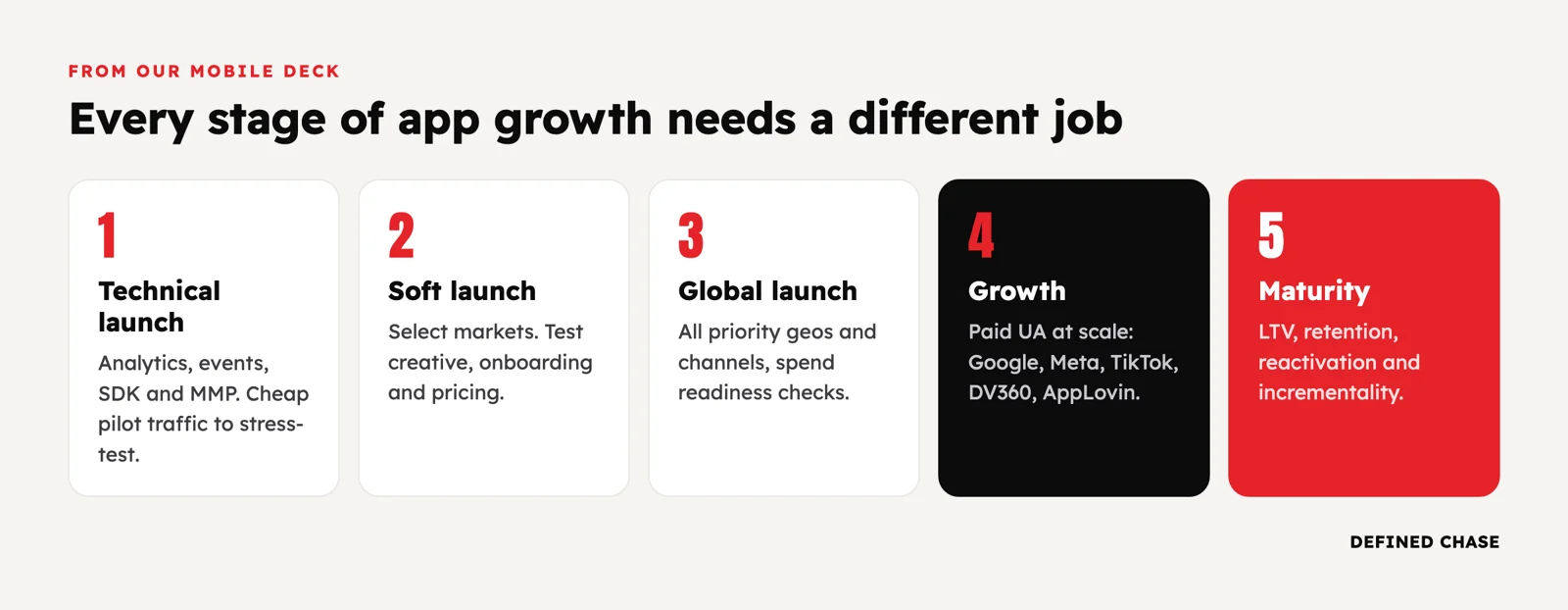
Which channels to use for mobile app user acquisition
| Channel | Best for | Watch out for |
|---|---|---|
| Google App campaigns | Android scale across Search, Play, YouTube and Display from one campaign; strong at in-app action and value bidding once volume is there | Little placement control; switching to ROAS bidding before you have enough daily conversions starves delivery |
| Meta app ads | Broad reach on iOS and Android, strong creative testing, value optimization with good signals | Creative fatigue at scale; iOS reporting relies on SKAdNetwork and modeling |
| TikTok | Younger audiences and native, creator-style video that drives installs | Needs a high volume of new creative; quality varies by market and optimization event |
| AppLovin | Large in-app inventory, strong for games and increasingly for non-game apps; ROAS campaigns when revenue events flow in | Needs clean revenue postbacks from your MMP; creative formats like playables matter |
| Apple Ads | High-intent App Store searches on iOS, including your brand and competitors | Limited volume; brand terms make results look better than new demand really is |
| Other networks and DSPs | Extra scale once the core channels bend | Inventory quality and fraud; test with strict rules |
Google App campaigns
Google App campaigns use your assets (text, images, videos and HTML5) and decide where to show them across Google’s network. Start by optimizing to a meaningful in-app action, such as a completed registration or first purchase, rather than installs. Move to target ROAS only when you have steady daily conversion volume and value data flowing through Firebase or your MMP. Feed new video and image assets every few weeks so the campaign has new material to test.
Meta
Meta works best for apps when it learns from a real value event, such as a subscription start or first purchase, and when it gets a steady flow of new creative. For iOS, configure SKAdNetwork conversion values so the earliest signal you can measure actually predicts revenue.
TikTok
TikTok rewards ads that look native: creator-led, fast, with a hook in the first seconds. Treat it as a creative channel first. Test many concepts with small budgets, then move budget to the few that hold their cost per paying user.
AppLovin
AppLovin reaches users inside other apps, mainly games, and its bidding works best when it receives revenue events through your MMP. For non-game apps, test with a fixed budget and judge on cohort ROAS, not installs. Playables and short video tend to matter more here than on social platforms.
ROAS cohorts: how to judge app UA at scale
Cohort ROAS is the revenue a group of users acquired in one period generates by a given day after install, divided by what you spent to acquire them. Day 7 ROAS (D7) is what one week’s installs paid back in their first seven days.
The trick is to set early targets from your own payback curve. If your history shows that users typically generate four times their D7 revenue by day 180, and you want spend paid back by day 180, then your D7 target is 25%.
Illustrative numbers, not a client result. A subscription app spends $250,000 a month, wants payback by day 180, and has a D7 target of 25%.
| Channel | Monthly spend | Cost per install | D7 ROAS | Decision |
|---|---|---|---|---|
| Google App campaigns | $100,000 | $2.80 | 28% | Above target: raise in steps |
| Meta | $90,000 | $3.40 | 24% | Near target: refresh creative before adding budget |
| TikTok | $35,000 | $1.90 | 14% | Cheap installs, weak payers: fix the event and creative or cut |
| AppLovin | $25,000 | $4.10 | 31% | Expensive installs, best payers: scale the test |
Judged on cost per install, TikTok wins and AppLovin loses. Judged on cohort ROAS, it is the opposite. That is the decision most teams get wrong.
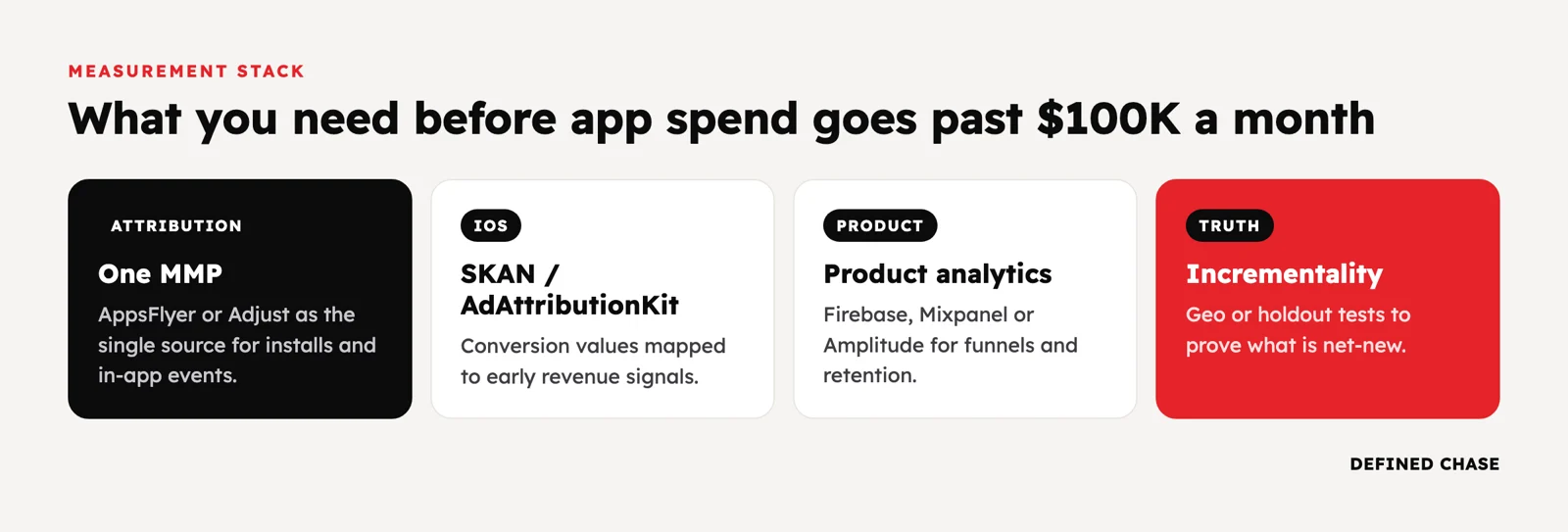
The measurement stack you need
- A mobile measurement partner. AppsFlyer, Adjust, Singular and Branch attribute installs and in-app events across networks and send postbacks to each one.
- Revenue events from your backend. Send subscription starts, renewals, refunds and purchases server to server, so the MMP and the networks see real money, not just client events.
- SKAdNetwork and AdAttributionKit setup. Map conversion values to the early actions that best predict revenue.
- Cohort reporting. One view of spend, installs, payers and ROAS by day for each channel, campaign and creative.
- Web-to-app tracking where relevant. If users sign up or pay on the web first, connect those events to the app user.
What to do next: a decision table
| Your situation | Next move |
|---|---|
| Scaling on one channel, cohort ROAS falling with each budget step | Test the next channel with a fixed budget and a D7 target |
| Cheap installs, few payers | Change the optimization event to a paying or high-intent action |
| Numbers differ between MMP, networks and backend | Fix revenue events and postbacks before raising budget |
| Creative wins fade within two weeks | Build a weekly concept pipeline; test angles, not variations |
| iOS looks much worse than Android | Review SKAdNetwork conversion values and the share of modeled data |
| Google and Meta at target, budget still to deploy | Raise in steps and hold each step for a full cohort read |
Common app UA mistakes
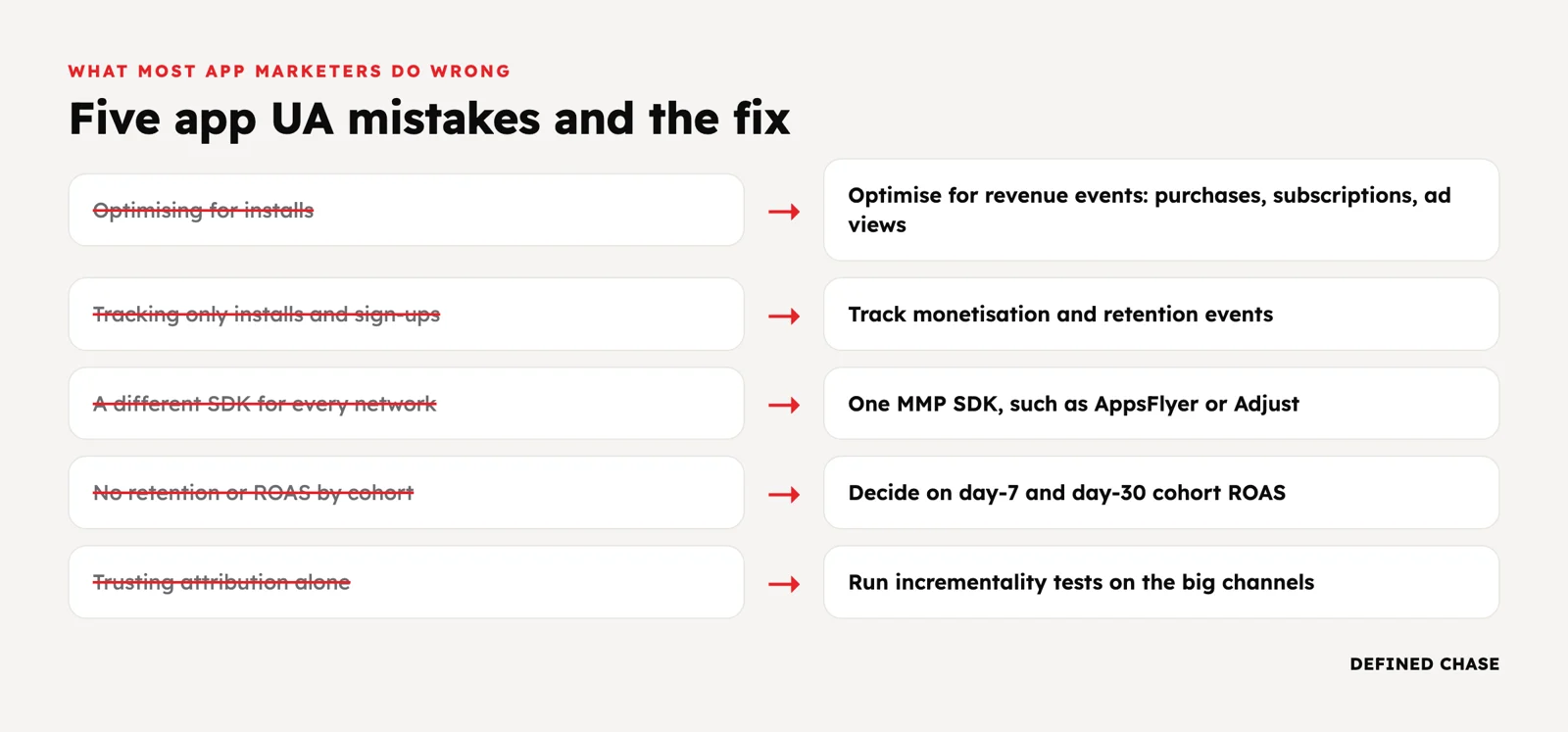
- Optimizing to installs or registrations when only a small share of users ever pay.
- Judging channels on cost per install instead of cohort ROAS.
- Scaling on D0 ROAS without checking how cohorts mature.
- Letting each network grade its own homework instead of reading cohorts from the MMP and backend.
- Running the same few creatives everywhere until they fatigue.
- Counting brand searches on Apple Ads as new demand.
How we run app UA at Defined Chase
We run app user acquisition for brands spending $100,000 or more a month across Google App campaigns, Meta, TikTok, AppLovin and other networks. We start with measurement (MMP setup, revenue events and cohort reporting checked against the backend), then build creative and budget rules around a payback target, and raise spend only when an agreed Scale Gate holds on the client’s own data.
A public example: for uniPark, a mobility app, we combined campaign restructuring, e-commerce and app tracking, and AI-powered reporting. In a verified Clutch review, uniPark reported stronger sales, ROAS and brand awareness. More in our case studies.
See how we work, or book a free 90-Day Growth Map Call to find what is capping your app’s next budget step.
FAQ
What is a good D7 ROAS for a mobile app?
There is no universal number. Work it out from your own payback curve: if users usually reach four times their D7 revenue by your payback day, a D7 of 25% means break-even. Subscription apps, games and fintech apps have very different curves.
Should Google App campaigns optimize for installs, actions or ROAS?
Installs only make sense when you are starting out or need volume for learning. Most scaled apps optimize to an in-app action that predicts revenue, and move to target ROAS once there is steady daily conversion and value data.
Is AppLovin only for games?
No. Games are its biggest category, but AppLovin also runs campaigns for non-game apps. Test it with a fixed budget and revenue events flowing through your MMP, and judge it on cohort ROAS.
Do I need a mobile measurement partner?
At $100,000 a month across several networks, yes. An MMP gives you one view of installs and in-app events across channels and sends the postbacks each network needs to optimize.
How does iOS App Tracking Transparency affect app UA?
Most iOS users do not opt in to tracking, so iOS performance is read through SKAdNetwork or AdAttributionKit postbacks and modeled data. Set conversion values around early actions that predict revenue, and compare against backend cohorts.
Updated 16 October 2026.
Want to scale your ad spend?
On a free Growth Map Call we find what is capping your ad spend and the next 1 to 3 steps.
Attend a Growth Map CallRelated articles
When to Add DV360 to Google and Meta: A Programmatic Guide for $100K+ Budgets
Short answer: add DV360 (Display & Video 360, Google’s demand-side platform) when Google Ads and Meta still work but each extra dollar…
Oct 16, 2026 · 7 min readSaaS Advertising: Which Ad Platforms Scale a SaaS Company
Explore the top advertising platforms to effectively scale your SaaS startup, reach a wider audience, and achieve business growth. Maximize your marketing…
Jul 3, 2024 · 4 min readUnderutilized Marketing Channels That Drive Significant Business Outcomes
Discover the untapped marketing channels that have the potential to drive substantial business outcomes. Unlock new opportunities for your brand's growth.
May 31, 2024 · 14 min read