
Short answer: add DV360 (Display & Video 360, Google’s demand-side platform) when Google Ads and Meta still work but each extra dollar there costs more, and you need reach they cannot give you: connected TV, premium publishers through private deals, audio, digital out-of-home, and one frequency cap across many exchanges. It usually makes sense once total spend is well past $100,000 a month and you can measure incrementality, not just last-click conversions. In practice it does two jobs: building awareness and new demand at scale (YouTube, connected TV, display, audio), and remarketing to people who already know you across the open web, with one frequency cap. It is the wrong move if your tracking is broken.
This guide is for brands already scaling on Google and Meta that are asking whether programmatic is the next channel. It covers what DV360 is, how it differs from Google Ads, when to add it, how to test it, and how to tell whether it worked.
What is DV360?
DV360 is Google’s demand-side platform (DSP), part of the Google Marketing Platform. A DSP lets you buy ad space programmatically across many ad exchanges and publishers from one place, with automated bidding on each impression. DV360 can buy display, video, YouTube, connected TV, audio and digital out-of-home inventory, on the open market or through private deals agreed with specific publishers.
Most brands access DV360 through an agency or a Google Marketing Platform partner that holds the seat, rather than signing up the way you would for Google Ads.
What is programmatic advertising, in one paragraph?
Programmatic advertising is the automated buying of ad impressions, one at a time, based on who is likely to see them and what the advertiser is willing to pay. Instead of booking a placement with each website, you set audiences, inventory rules, bids and budgets in a DSP, and it buys across thousands of sites, apps and streaming services. DV360, The Trade Desk and Amazon DSP are among the best-known DSPs.
DV360 vs Google Ads: what is the difference?
| Google Ads | DV360 | |
|---|---|---|
| Inventory | Google Search, YouTube, Google Display Network, Discover, Gmail, Maps | YouTube plus many third-party exchanges, premium publishers, connected TV, audio and digital out-of-home |
| Buying types | Auction, mostly automated by Google | Open auction, private marketplace deals, preferred deals and programmatic guaranteed |
| Control | Increasingly automated campaign types | Line-item control over inventory, sites, apps, frequency and brand safety |
| Frequency management | Within Google’s own inventory | Across exchanges and formats in one plan |
| Best for | Capturing demand and driving conversions directly | Building new demand at scale with control over where ads appear |
| Access | Self-serve | Usually through an agency or partner seat |
When should you add DV360 to Google and Meta?
| Your situation | Add DV360 now? | Why |
|---|---|---|
| Marginal CAC on Google and Meta is rising, tracking is clean, and you want new demand | Yes, test it | This is the classic case: the walled gardens are bending and you need reach elsewhere |
| Your buyers watch streaming TV more than social, or you sell a considered purchase | Yes | Connected TV and premium video reach people your social ads miss |
| You need to be seen on specific publishers, or brand safety rules are strict | Yes | Private deals and inventory lists give you control Google Ads does not |
| You run in several markets and want one frequency plan across formats | Often | One DSP is easier to cap and measure than many direct buys |
| Tracking does not match real sales | Not yet | You will not be able to tell if programmatic added anything |
| You want to remarket to site and app visitors beyond Google and Meta | Yes, with a holdout | Remarketing across the open web and YouTube brings people back, but measure it against a holdout so it does not take credit for sales that would have happened anyway |
| Google and Meta still scale at your target cost | Not yet | Spend the next dollar where it still works; add channels when the current ones bend |
Which DV360 formats to test first
| Format | Test it first when | How to judge it |
|---|---|---|
| Connected TV | You sell to a broad audience and already have video that works on YouTube or Meta | Lift in total sales and branded search in test regions |
| Premium video and private deals | Brand safety matters or your buyers read specific publishers | Reach of new people, cost per incremental customer |
| YouTube through DV360 | You want one frequency cap across YouTube and other video | Unique reach and frequency against the same spend in Google Ads |
| Audio and digital out-of-home | You are already strong on video and want extra reach in key cities | Geo tests only; direct attribution will be thin |
| Open-exchange display | Last, with strict allow lists | Incremental sales, not clicks or view-through |
How to test DV360 properly
Illustrative numbers, not a client result. A brand spends $400,000 a month: $220,000 on Google and $180,000 on Meta. The last two budget steps on Meta bought customers at roughly 40% above target, while Google brand and non-brand search is close to its ceiling.
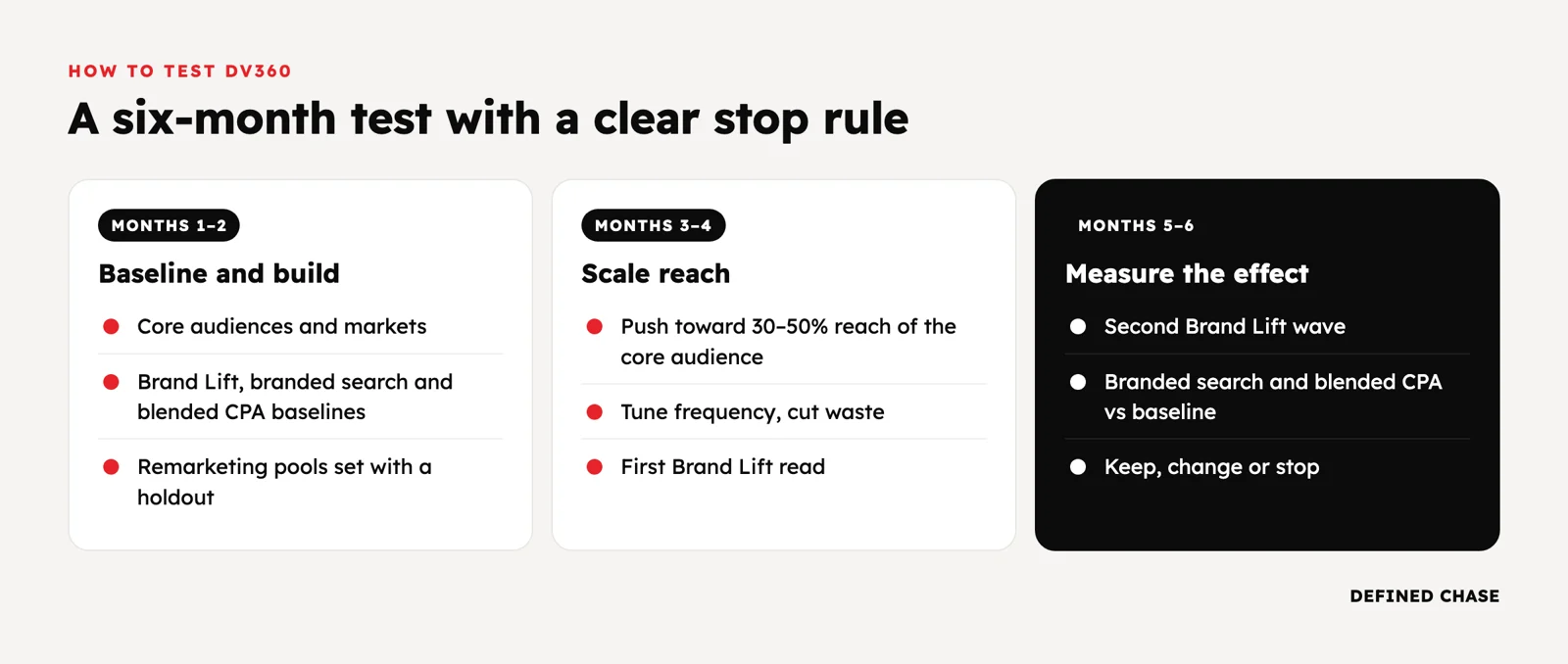
- Set the budget and length. Move about 10% of spend, $40,000 a month, into a DV360 test for at least six to eight weeks. Smaller tests spread across many line items rarely produce a readable result.
- Pick one job. For example, prospecting on connected TV and premium video in two markets, not “programmatic” in general.
- Write the success rule first. For example: total new customers in test regions grow by enough that the incremental cost per customer stays within 20% of target, measured in your own sales data.
- Use a holdout. Run the test in some regions and keep comparable regions dark. Compare total sales, branded search and direct traffic, not just DV360-reported conversions.
- Decide at the end. Scale the format that cleared the rule, cut the rest, and move to the next test.
If the test regions added 280 new customers for $40,000, that is about $143 each. Whether that is good depends on the target you wrote down before you started, which is the point of writing it down.
How to measure programmatic without fooling yourself
- Treat view-through conversions with suspicion. Someone who saw a banner and later bought may have bought anyway. Use them as a signal, not as proof.
- Prefer incrementality. Geo holdouts, conversion lift studies and matched-market tests tell you what the channel added.
- Watch the halo. Good upper-funnel programmatic often shows up as more branded search and direct traffic. Track those in the test regions.
- Connect conversions properly. Use Floodlight or linked Google Analytics 4 conversions, checked against your backend, so DV360 bidding learns from real outcomes.
Common DV360 mistakes
- Buying cheap open-exchange inventory. Low CPMs often mean low-quality sites, made-for-advertising pages and accidental clicks.
- No inventory and brand safety rules. Start from allow lists and verified deals, then widen carefully.
- Judging it on last click. Prospecting video and CTV will look weak on last click and strong on view-through. Neither is the truth; incrementality is.
- Remarketing only, with no awareness or prospecting layer. It takes credit for customers your other channels already won.
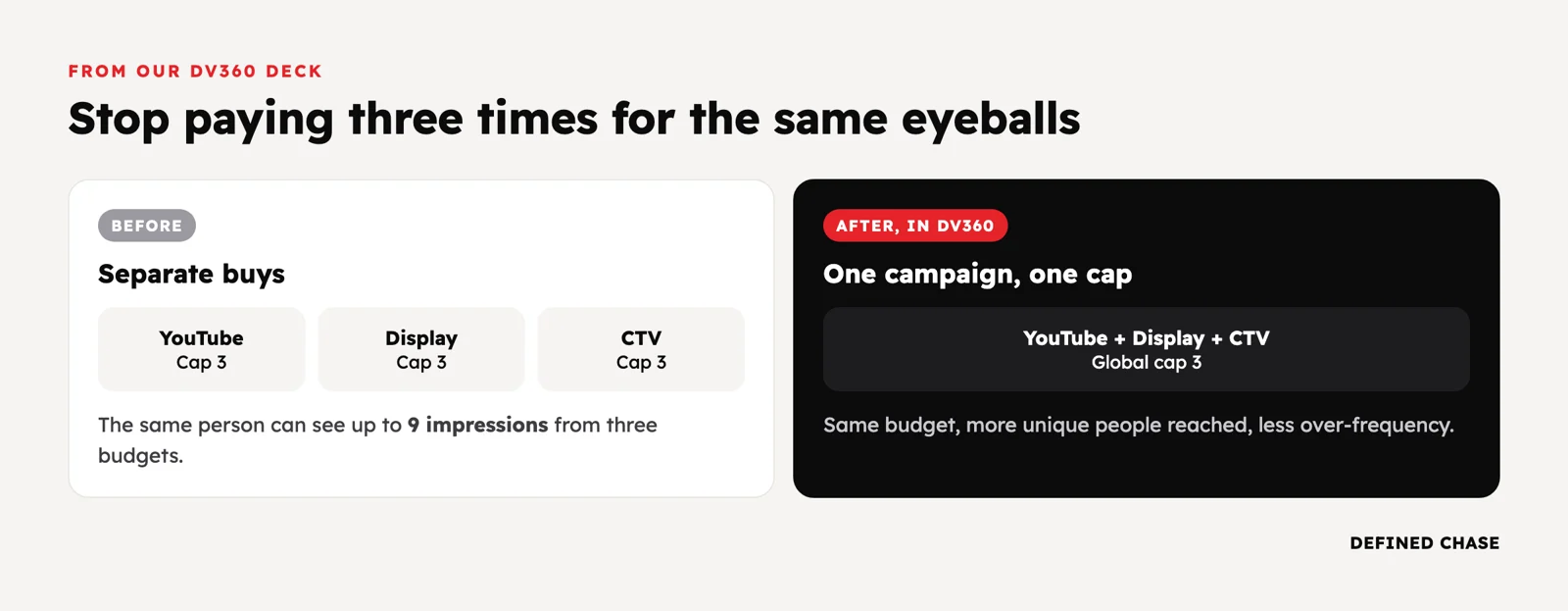
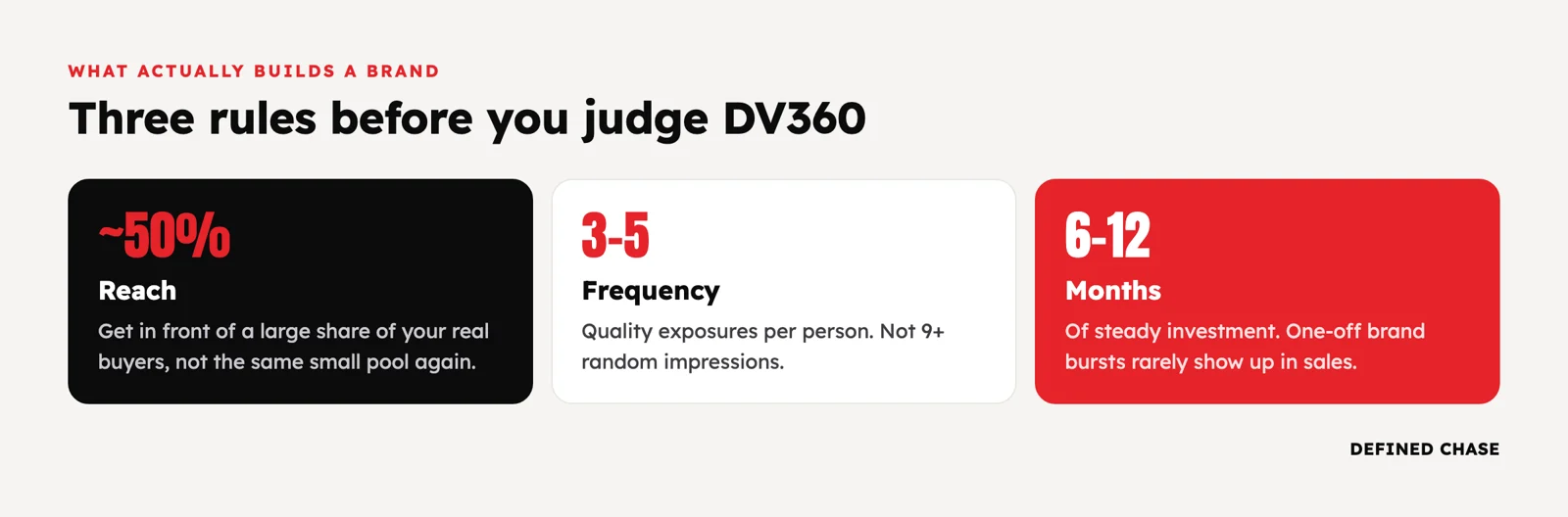
- Uncapped frequency. The same person seeing your ad twenty times a week is spend you could have used to reach someone new.
- Too little budget, too many line items. Each line item needs enough spend to learn.
How we run it at Defined Chase
We run campaigns across Google, Meta, TikTok, DV360 and app networks for brands that spend $100,000 or more a month. We only add a channel when the current ones show rising marginal cost, the tracking is trustworthy enough to read the test, and there is a written success rule measured on the client’s own data. Programmatic then gets a fixed test budget and a clear job, and it earns more budget only when the gate holds.
We have managed and analyzed more than $100M in ad spend over 13+ years. See our case studies and how we work, or book a free 90-Day Growth Map Call to find out whether a new channel or a fix on your current ones is the next step.
FAQ
Is DV360 worth it?
It is worth it when you need reach and control that Google Ads and Meta cannot give you, and when you can measure what it adds. Its main jobs are awareness at scale and remarketing to people who already know you, both measured against a holdout. It is rarely worth it while tracking is broken.
What is the minimum budget for DV360?
Google does not publish a single minimum, and seat access usually comes through an agency or partner. In practice, a test needs enough budget per line item to learn and enough weeks to read the result. Fewer, better-funded line items beat many small ones.
Can you run YouTube ads in DV360?
Yes. DV360 can buy YouTube inventory alongside other video, connected TV and display, which helps when you want one frequency and reach plan across formats.
What is the difference between DV360 and The Trade Desk?
Both are demand-side platforms. DV360 is part of Google’s stack and works closely with YouTube and Google’s measurement tools. The Trade Desk is independent and is often chosen for connected TV and cross-publisher buying outside Google. The right one depends on your inventory needs and measurement setup.
Is programmatic advertising only for brand awareness?
No, but awareness is its biggest job. The other big one is remarketing: bringing back site and app visitors across the open web and YouTube. It can drive sales directly too. Judge it on what it adds to total sales in a controlled test, not on the conversions it reports for itself.
Updated 16 October 2026.
Want to scale your ad spend?
On a free Growth Map Call we find what is capping your ad spend and the next 1 to 3 steps.
Attend a Growth Map CallRelated articles
Mobile App User Acquisition Past $100K a Month: Google App Campaigns, Meta, TikTok and AppLovin
Short answer: to scale mobile app user acquisition past $100,000 a month, stop judging channels on cost per install and judge them…
Oct 16, 2026 · 6 min readSaaS Advertising: Which Ad Platforms Scale a SaaS Company
Explore the top advertising platforms to effectively scale your SaaS startup, reach a wider audience, and achieve business growth. Maximize your marketing…
Jul 3, 2024 · 4 min readUnderutilized Marketing Channels That Drive Significant Business Outcomes
Discover the untapped marketing channels that have the potential to drive substantial business outcomes. Unlock new opportunities for your brand's growth.
May 31, 2024 · 14 min read