Short answer: A Brand Lift study in DV360 or Google Ads shows a short survey to people who saw your ads and to a control group who did not, then reports the difference in ad recall, awareness, consideration or purchase intent. To connect it to sales, do not stop at the lift. Track four numbers together: lifted users and cost per lifted user from the study, branded search volume, direct and organic traffic, and blended CPA (total spend divided by all new customers, from your own data). Report awareness spend on its own line, never inside performance CPA. Plan for reach of about half your real buyers, 3 to 5 exposures a week and 6 to 12 months of steady spend, then judge it with two lift waves and the trend in blended CPA, not last-click ROAS.
This guide is for teams spending $100,000 or more a month who already run awareness on YouTube, connected TV or display through DV360 or Google Ads, or plan to, and need to prove to a CEO or finance team that it pays back. If you are still deciding whether programmatic is the next channel at all, start with when to add DV360 to Google and Meta. This article picks up where that one stops: what a Brand Lift study measures, how to run one that gives a readable answer, and how to tie it to the cost of a new customer.
What we hear about brand spend on growth strategy calls
Awareness budgets are the first to be questioned and the hardest to defend. On growth strategy calls the doubts sound like this:
- “We don’t know how to measure the impact of it. We basically burned the money just for the branding and it gave nothing out of the reach.”
- “We are really numbers-based companies. The brand awareness, we don’t see the immediate impact, and then it just doesn’t go through the top management.”
- “Sales often says, nobody knows us.”
- “We are getting huge frequency, at least by their metrics.”
The findings behind them repeat. A software company’s monthly report put its DV360 awareness spend inside the cost per acquisition, so the brand layer made performance look worse every month. An app compared DV360 with Google Ads on last click and post-view and got two different stories from the same settings. An apparel brand reached the same warm people almost six times because cold campaigns did not exclude existing customers. In each case the brand work was not proven wrong. It was never set up to be proven at all.
What a Brand Lift study measures
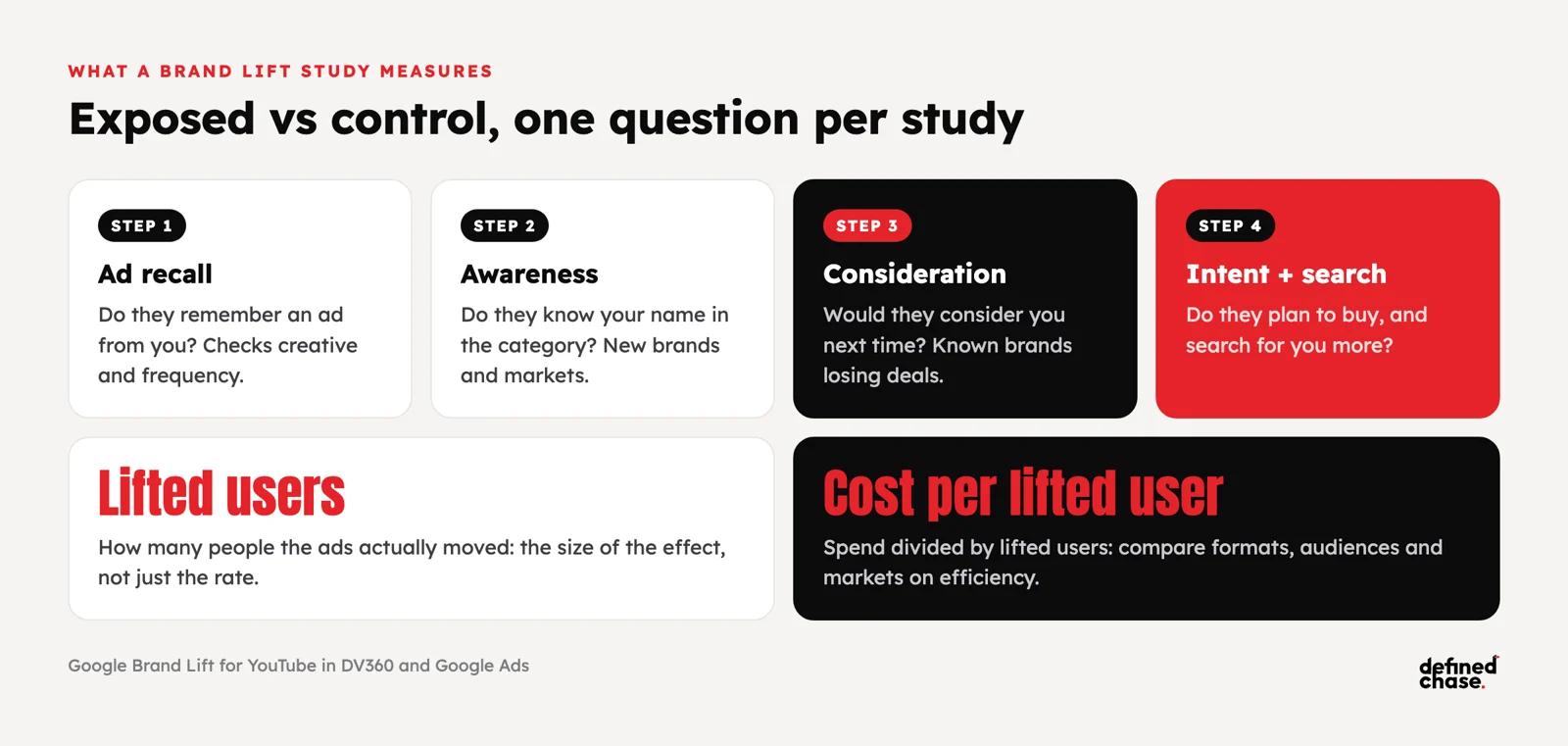
Brand Lift is Google’s survey-based measurement for YouTube and video campaigns, available in DV360 and in Google Ads. Google splits the audience into an exposed group and a control group that is held back from your ads, asks both a one-question survey on YouTube, and reports the difference. A related search lift study measures the increase in searches for your brand on Google and YouTube among people who saw the ads.
| Metric | What it tells you | Use it for |
|---|---|---|
| Ad recall | Do people remember seeing an ad from your brand? | Checking that the creative and frequency register at all |
| Awareness | Do more people know your brand name in the category? | New or small brands, new markets |
| Consideration | Would they consider you next time they buy? | Known brands that lose deals to competitors |
| Purchase intent | Do they plan to buy from you? | Categories with short decision cycles |
| Search lift | Did exposed people search for your brand more? | The closest link between awareness and demand you can bid on |
| Absolute lift | Exposed minus control, in percentage points | Comparing waves of the same study |
| Lifted users | How many people the ads actually moved | The size of the effect, not just the rate |
| Cost per lifted user | Spend divided by lifted users | Comparing formats, audiences and markets on efficiency |
Pick one question per study. A brand nobody knows should measure awareness; a known brand losing on price should measure consideration. Asking about everything spreads the sample thin and usually returns “not significant” on all of it.
How to connect brand lift to blended CPA
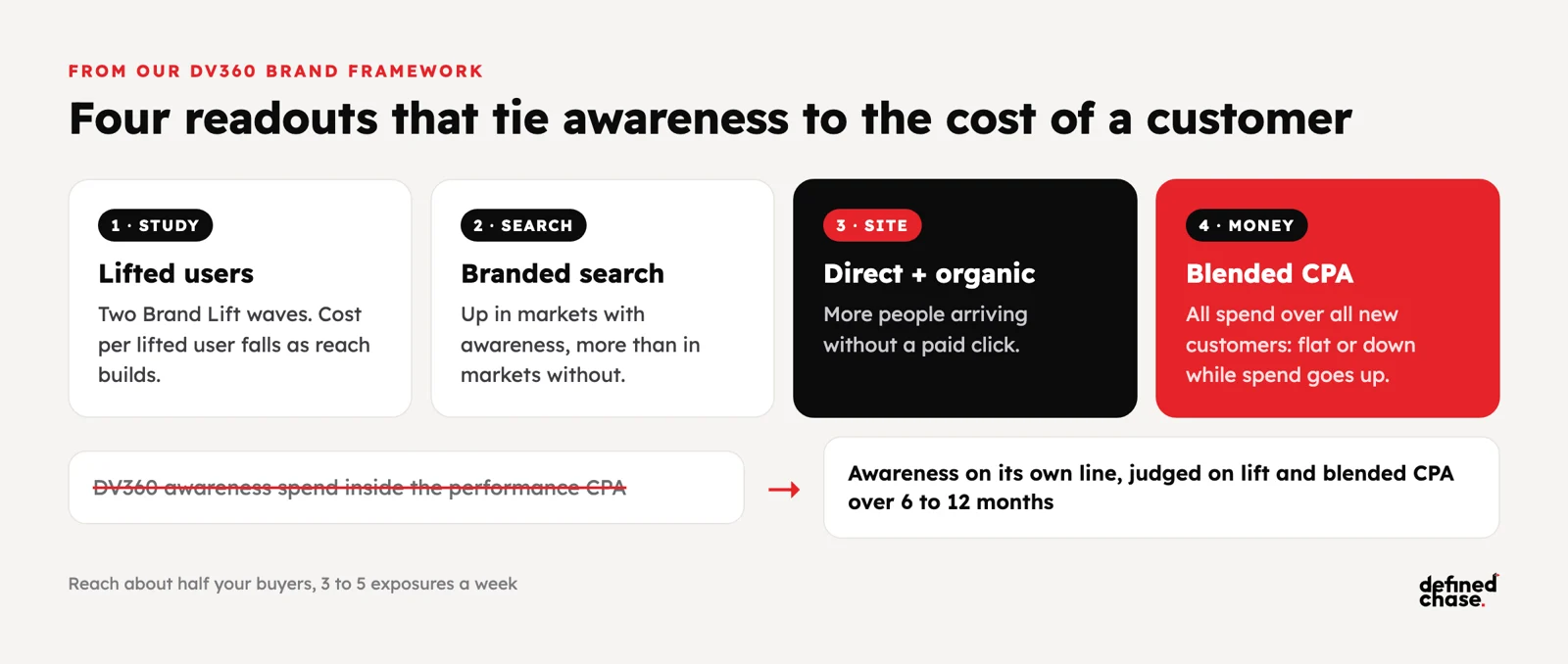
A lift in ad recall on its own will not convince a finance team. The study proves people noticed. The link to money is a chain of four readouts that should move in the same direction over months, measured in your own data where possible:
| Readout | Where it comes from | What good looks like after 6 to 12 months |
|---|---|---|
| Lifted users and cost per lifted user | Brand Lift study, two waves | A significant lift in the second wave, at a cost per lifted user that falls as reach builds |
| Branded search volume | Google Ads and Search Console, test markets against the rest | Brand searches up while awareness runs, more than in markets without it |
| Direct and organic traffic | Your analytics, by market | More people arriving without a paid click |
| Blended CPA | Total marketing spend divided by all new customers, from your backend | Flat or falling while total spend goes up |
Two reporting rules make the chain readable. First, awareness goes on its own line. If DV360 brand spend sits inside the performance CPA, every month of brand building looks like a performance problem and the budget gets cut before it can work. Second, judge performance on non-brand cost per new customer, and the whole business on blended CPA. Brand campaigns will look better as awareness grows, so they cannot be the proof. For the one-page version a CEO reads, see the monthly CEO marketing report.
How to set up a study that gives a readable answer
Most brand lift studies that come back empty were too small, too short or too scattered. Our DV360 brand framework sets the conditions before the first impression:
- Reach about half your real buyers. Below that, the effect is too small to show up in the survey or in search. Define the buyer base by market, age and interest first, then size the reach.
- 3 to 5 quality exposures per person a week, not 9 or more. When YouTube, display and connected TV are bought as separate campaigns, each with its own cap of 3, the same person can see 9 ads. One DV360 campaign with one global frequency cap keeps it at 3 and spends the rest on new people.
- One job and one question. For example, consideration among 25 to 44 year olds in two markets, not “awareness” everywhere.
- Creative made for the format. A phone-shot UGC ad that works on Meta will not carry a non-skippable connected TV slot. Build a consistent visual identity and keep it long enough to be remembered, instead of rotating many unrelated ads.
- A baseline before launch. Record branded search, direct traffic and blended CPA by market for the months before, so the after has something to compare with.
- Two waves. A first read at months 3 to 4 to tune frequency and formats, and a second at months 5 to 6 against the first.
Google sets minimum spend and sample requirements for each study, depending on the market and the questions. Check eligibility in the account before you plan the flight, because a study that cannot reach its sample is spend you cannot read.
Brand Lift in DV360, Google Ads and Meta
The method is the same everywhere: an exposed group, a held-out control group and a survey. What differs is what it can cover.
| Question | DV360 | Google Ads | Meta |
|---|---|---|---|
| What it measures | YouTube video bought through DV360, inside one plan with display and connected TV | YouTube video and Demand Gen campaigns | Facebook and Instagram campaigns |
| Frequency control | One global cap across exchanges and formats | Within Google’s own inventory | Within Meta |
| Search lift | Yes, for YouTube | Yes | No; use your own branded search data |
| Best for | Always-on brand layers across video, display and connected TV | Brands whose awareness spend is mostly YouTube | Brands whose awareness spend is mostly social |
| Watch out for | Only part of the plan is covered by the survey | Many small campaigns that never reach the sample | Comparing its lift with Google’s as if the surveys were the same |
Do not compare lift numbers across platforms. Each platform surveys its own users with its own questions. Compare branded search and blended CPA instead, because they are measured the same way whatever drove them. For lift tests on sales rather than surveys, use a geo holdout, covered in our guide to incrementality and marketing mix modeling.
How to read the results and decide
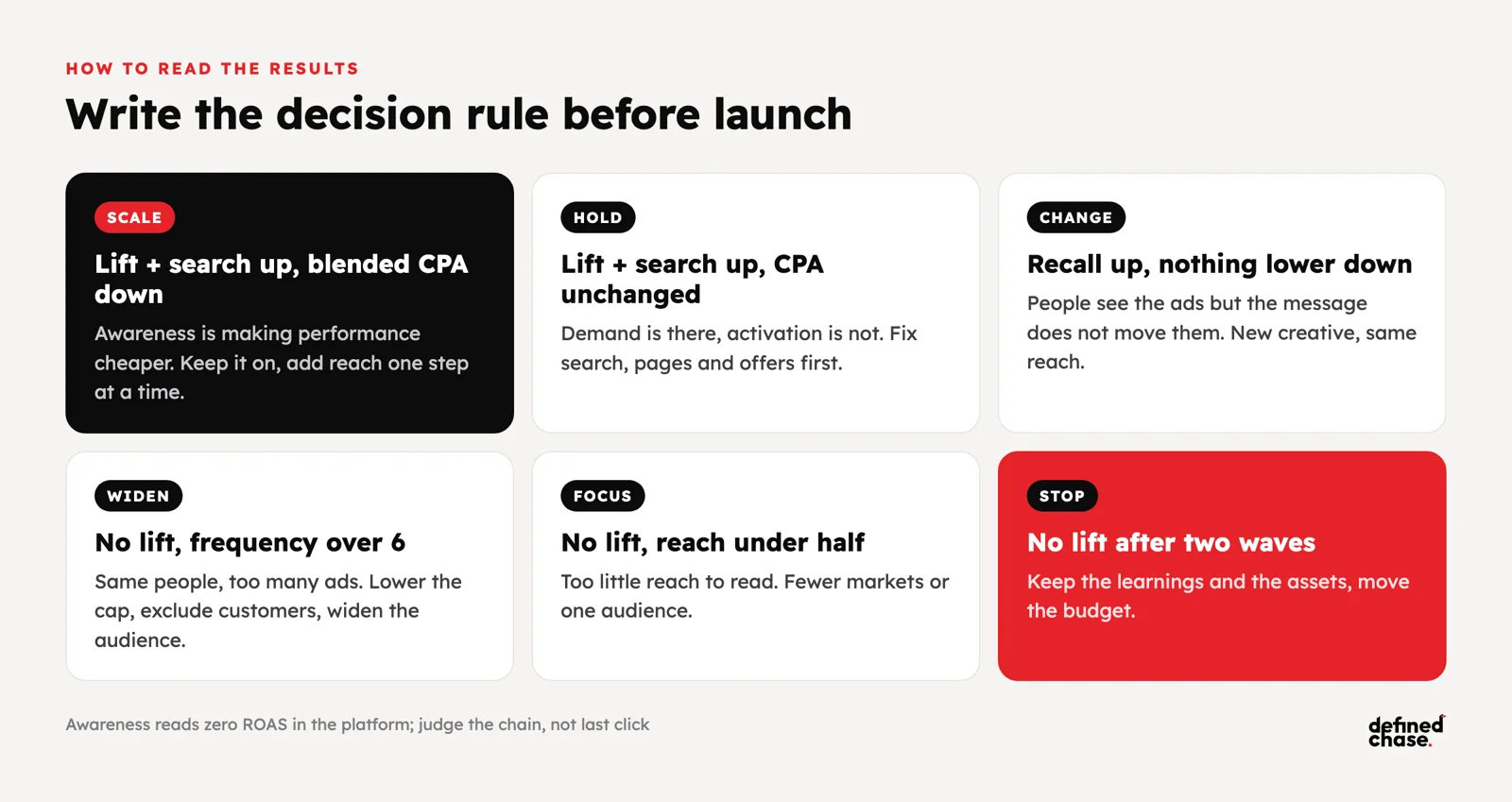
Write the decision rule before launch, then apply it to what comes back:
| What you see | What it usually means | Decision |
|---|---|---|
| Significant lift, branded search up, blended CPA flat or down | Awareness is making performance cheaper | Keep it always on and scale reach one step at a time |
| Significant lift, branded search up, blended CPA unchanged | People know you, but search, pages or offers do not convert the extra demand | Hold the budget and fix the activation side first |
| Ad recall up, no lift lower down | People saw the ads but the message does not move them | Change the message and creative, keep the reach |
| No significant lift, frequency over 6 | The same people are seeing too many ads | Widen the audience, lower the cap, exclude existing customers |
| No significant lift, reach well under half the buyers | Too little reach to read | Concentrate budget on fewer markets or one audience, or stop |
Expect awareness to look weak on last click, and do not let anyone switch it off on that basis. As we tell clients at onboarding: the return on an awareness line will read zero in the ad platform, because it is measured on reach, frequency and lift, not on purchases. What it has to show is the chain above moving in the right direction.
Common brand lift mistakes
- Brand spend inside performance CPA. It makes both look wrong. Two lines in the report, always.
- One-off bursts. A two-week flight before a sale rarely moves anything you can measure. Brand effects compound over 6 to 12 months of steady spend.
- Too many studies, too little budget. Fewer, better-funded studies on one question beat a survey on every campaign.
- No baseline. Without the months before, nobody can say whether branded search rose because of the ads or because of the season.
- Uncapped frequency across separate buys. Nine ads to one person is spend that could have reached two more.
- Judging awareness on view-through conversions. They are a signal, not proof. Someone who saw a banner and bought may have bought anyway.
How we run it at Defined Chase
We run DV360 and YouTube awareness as an always-on layer on top of the performance channels, never instead of them. Before launch we agree the buyer base, the reach and frequency target, one lift question and the baseline for branded search, direct traffic and blended CPA, and we put awareness on its own line in the weekly scorecard. A first Brand Lift read at months 3 to 4 tunes formats and frequency; a second wave at months 5 to 6 decides whether the layer grows, holds or stops, on the rule written down at the start. See how we run programmatic and DV360 for brands spending $100K+ a month, or book a free Growth Map Call to find out whether awareness or a fix on your current channels is the next step.
FAQ
What is a Brand Lift study?
A survey-based test that compares people who saw your ads with a control group who did not, and reports the difference in ad recall, awareness, consideration, favourability or purchase intent. Google runs it for YouTube and video campaigns in DV360 and Google Ads; Meta has its own version.
How do you measure brand awareness against CPA?
Keep awareness spend on its own line, then track lifted users, branded search, direct and organic traffic and blended CPA together over 6 to 12 months. If awareness works, branded search rises and blended CPA stays flat or falls while total spend grows.
What is cost per lifted user?
Media spend divided by the number of people the ads moved on the survey question. It lets you compare formats, audiences and markets on how cheaply they change minds, not just how cheaply they buy impressions.
How long should a brand lift study run?
Long enough to reach the survey sample, usually several weeks. For a decision about an awareness budget, plan two waves across about six months, because brand effects build with steady reach.
What frequency builds brand awareness?
Our working rule is 3 to 5 quality exposures per person a week, reaching about half of your real buyers. Above that you mostly pay to show the same people the same ad again.
Can you run Brand Lift in DV360?
Yes, for YouTube inventory bought through DV360. The rest of a DV360 plan, such as display and connected TV, is not covered by the YouTube survey, so read it through branded search, direct traffic and geo tests.
Why does brand awareness show no ROAS?
Because it is bought on reach and frequency, not on clicks, and most of its effect arrives later through branded search, direct visits and cheaper performance. Judge it on lift and blended CPA, not last-click return.
Updated 28 October 2026.
How we do this for clients: Server-side tracking and GA4 →
Want to scale your ad spend?
On a free Growth Map Call we find what is capping your ad spend and the next 1 to 3 steps.
Attend a Growth Map CallRelated articles
Marketing Attribution: Why GA4, Meta and Google Ads Disagree
Why GA4, Meta and Google Ads report different conversions, which attribution model to use, and how to set one source of truth…
Nov 6, 2026 · 8 min readIncrementality and Marketing Mix Modeling: A Practical Guide at $100K+
How to measure what your ads really add at $100K+ a month: attribution vs incrementality vs MMM, geo holdouts, conversion lift, brand…
Oct 22, 2026 · 9 min readCEO marketing report: spend to payback on one page
What a monthly CEO marketing report should show at $100K+ a month: spend, revenue, new customers, CAC payback, LTV:CAC and one budget…
Oct 20, 2026 · 8 min read