
Short answer: A Google Ads audit for an account spending $100,000 or more a month should check, in this order: whether conversions are real and counted once, which conversion actions the bids learn from, how brand and non-brand are split (including brand inside Performance Max), where spend goes on search terms with no sales, what Performance Max does with your URLs, how much of the market you are winning and why, and whether ads and landing pages match the search. Most stalled accounts we see are not short of budget or ideas. They are bidding on wrong or double-counted conversions and paying for their own brand, so the fix comes before any budget increase.
This guide is for marketing leads and founders whose Google Ads growth has stalled at $100K or more a month, often with an agency that reports green numbers while new customers stay flat. It lists what a real audit checks, what each check usually finds, and what to do with the answer. It is written from Google Ads accounts we have reviewed with teams on growth strategy calls. For the deeper Performance Max question, see Performance Max vs Search at scale.
What we hear on growth strategy calls when Google Ads stalls
The complaint is rarely “Google Ads does not work”. It is that spend went up and the business did not move. The same findings come back from account to account:
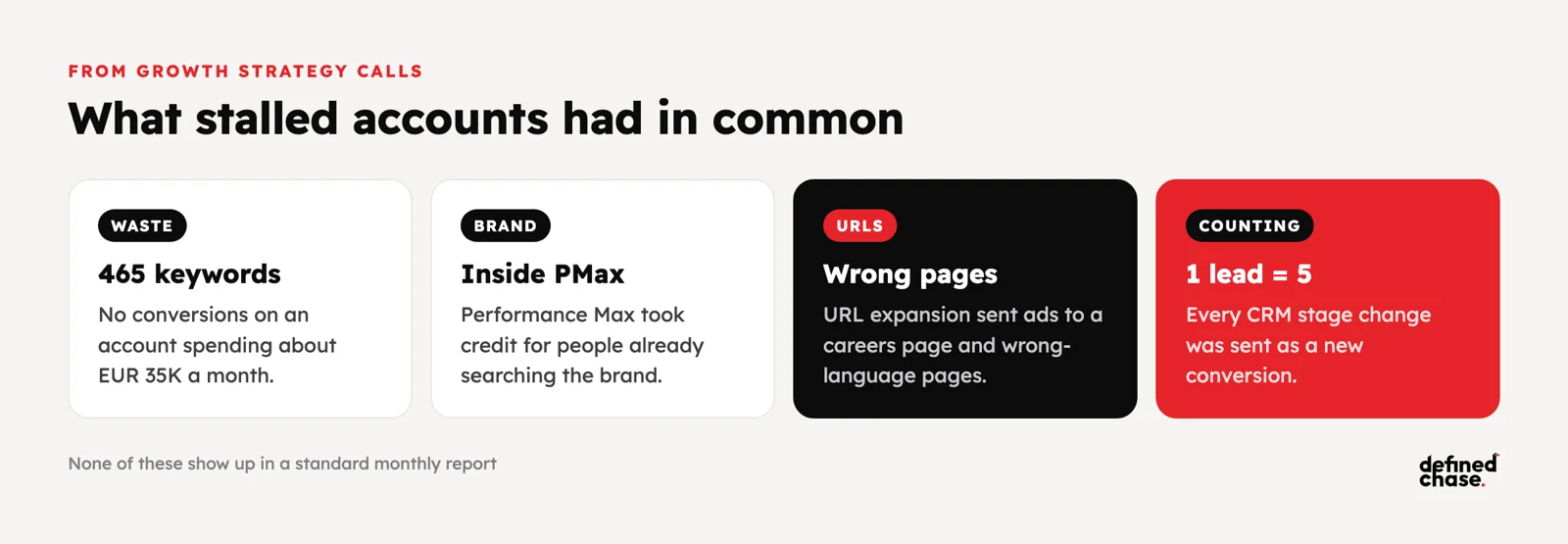
- One account spending about EUR 35,000 a month had 465 keywords with zero conversions; on another, 455 search terms brought no conversions and more than 225 converted above the average cost.
- The brand name was inside a Performance Max campaign, so Performance Max took credit for people who were already searching for the company, and a competitor’s name sat in the brand campaign.
- Performance Max final URL expansion sent ads to a careers page and, in one market, to pages in the wrong language.
- A CRM sent a conversion every time a lead changed stage, so one lead was counted up to five times, and the bids learned from the duplicates.
- A payment gateway appeared as a traffic source in analytics and took the credit for most of the revenue.
- A B2B account won only about 26% and 50% of the searches in its two main campaigns, while Google learned from phone clicks and form fills instead of qualified enquiries.
None of these show up as a red flag in a standard monthly report. Each one makes the account look either better or worse than the business result, and each one teaches Google’s bidding to buy the wrong thing.
What should a Google Ads audit check?
A Google Ads audit should check nine things, starting with the data the bids learn from and ending with the ads and pages people see. Checking keywords and ad copy first is the most common mistake, because nothing else can be trusted until the conversions are right.
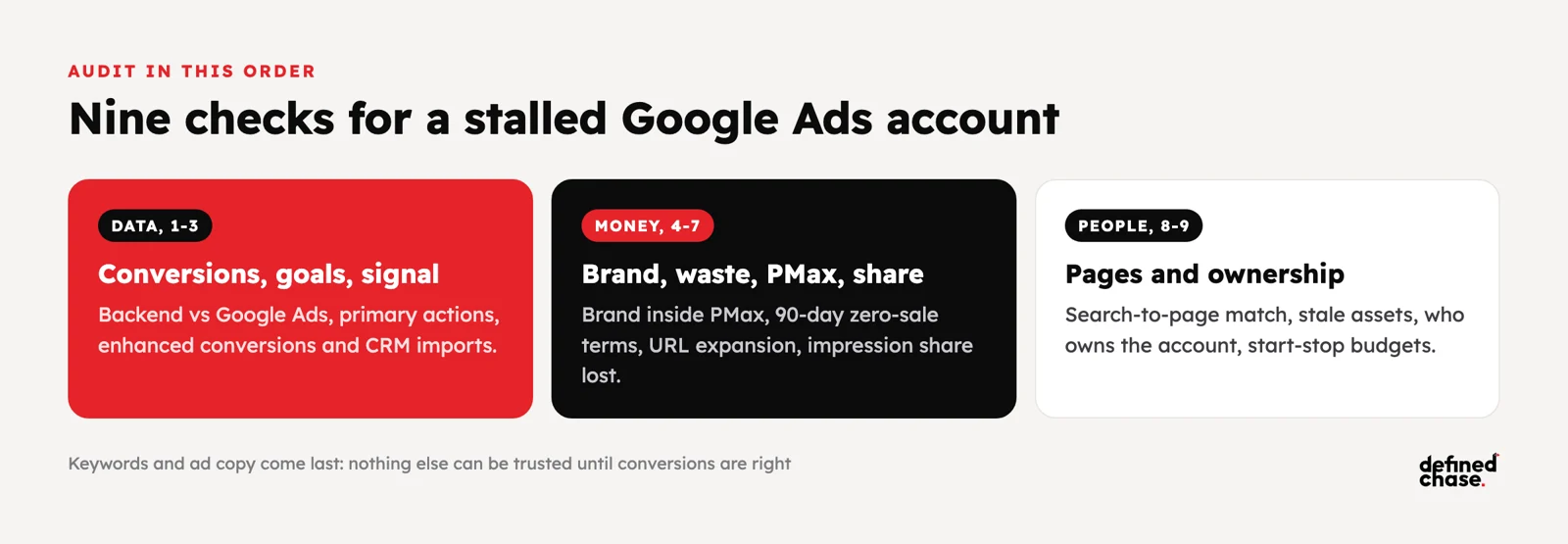
| Check | What to look at | What it usually finds |
|---|---|---|
| 1. Conversion truth | Google Ads conversions against real orders, deals or paying users from your backend, by week | Duplicate counting, missing purchases, page views or micro-events counted as sales |
| 2. Bidding goals | Which conversion actions are primary and used for bidding, and their values | Bids learning from add-to-cart, phone clicks or every form fill instead of the sale |
| 3. Signal quality | Enhanced conversions, consent mode, offline imports of qualified leads, data retention in analytics | Lost conversions after consent, no CRM feedback, retention left at two months |
| 4. Brand vs non-brand | Brand terms in Search and inside Performance Max, brand exclusions, competitor terms | Performance Max buying the brand and reporting it as new demand |
| 5. Search term waste | Spend on terms and keywords with no conversions over 90 days, negative keyword lists | Non-brand spend on terms that have not converted in 90 days |
| 6. Performance Max set-up | Final URL expansion, URL exclusions, asset groups, feed and audience signals | Ads landing on job, blog or wrong-language pages |
| 7. Market share | Impression share and the share lost to budget and to rank, by campaign | Campaigns capped by budget while weaker ones get the money |
| 8. Ads and landing pages | Message match between search, ad and page; outdated creative; page speed on mobile | Seasonal assets still live, one page for every intent |
| 9. Ownership and history | Who owns the account, the change history, how often budgets are paused and restarted | Agency-owned accounts, start-stop budgets that reset learning |
For check 5, use your own 90-day search terms report as the source: it shows the actual searches that triggered your ads and what each one cost (Google Ads Help: About the search terms report).
How do you check that Google Ads conversions are real?
Put Google Ads conversions next to real outcomes from your own backend, week by week, and explain the gap before you trust any CPA or ROAS. A gap is normal; a gap nobody can explain means the bids are learning from noise.
Then open the conversion actions. Google Ads only bids on the actions marked as primary in the goal a campaign uses; secondary actions are reported but not used for optimisation (Google Ads Help: About primary and secondary conversion actions). In stalled accounts we often find add-to-cart, page views, phone-number clicks or every CRM stage change set as primary. Each one teaches Google to find more of the cheap action, not more customers.
Last, check the signal. Enhanced conversions send hashed first-party data, such as the email address from the order, to improve conversion measurement (Google Ads Help: About enhanced conversions). For lead generation, import qualified leads and closed deals from the CRM, so Google learns which clicks became revenue. Our guides to server-side tracking and why GA4, Meta and Google Ads disagree cover the set-up.
Is Performance Max buying your own brand?
Often, yes. Unless brand terms are excluded, Performance Max can serve on searches for your own name and take credit for customers who were coming anyway, which makes its ROAS look strong while new-customer growth stays flat.
Check three things. First, the search terms and insights for Performance Max: how much of its conversion value comes from brand queries. Second, whether brand exclusions are set; Google offers them for Search and Performance Max campaigns (Google Ads Help: About brand settings for Search and Performance Max). Third, final URL expansion. It is on by default in Performance Max and lets Google swap your landing page for another page on your domain, which Google itself notes can send ads to unintended pages unless URL exclusions are managed (Google Ads Help: About Final URL expansion in Performance Max). That is how ads end up on careers pages and wrong-language pages.
On one e-commerce account, brand searches were 2.8% of clicks but 11% of the revenue credit. Excluding the brand from Performance Max and running it in its own Search campaign does not lose those sales. It shows what Performance Max adds on its own, which is the number you should scale on.
Where does Google Ads spend go to waste?
Most waste sits in search terms and keywords that spend for months without a conversion, in budgets spread across too many campaigns, and in automated expansions nobody reviews. It is found in the search terms report, not in the campaign overview.
- Zero-conversion terms. Sort 90 days of search terms by cost with no conversions. Exclude what is clearly irrelevant; for the rest, check the landing page before you cut.
- Competitors in the brand campaign. A competitor’s name in the brand campaign inflates brand results and hides what competitor bidding costs. Give competitors their own campaign and budget.
- Overlapping automation. Dynamic Search Ads with page feeds, broad match and Performance Max can all pick up the same searches. On one account, switching off a DSA campaign stopped it taking search terms from every other campaign.
- Out-of-date assets. Ads with Christmas or sale visuals still serving weeks later are a sign nobody reviews assets.
How much of the market are you winning?
Look at search impression share and why the rest is lost: to budget or to rank. A campaign that wins 26% of its searches and loses the rest to budget can grow, while one at 96% has almost no room left and every extra dollar buys the most expensive clicks.
Above about 90% impression share on non-brand terms, the last few points usually cost far more per conversion than they return. Below 50% with most of the loss to budget, the account has headroom, if the conversions in checks 1 to 3 are real. Move money from campaigns that are capped by rank or by cost toward the ones losing share to budget at a cost per new customer you can afford.
What should you do when your agency is underperforming at $100K+ a month?
Before changing agency, run the audit on your own account and ask the agency to answer each finding in writing, with dates. If the account is in your name and the data is clean, a good team can fix most of these issues in weeks; if the agency owns the account or cannot explain the conversion gap, that is the answer.
Three questions separate a stall you can fix from a team you should replace:
- Which conversion does each campaign bid on, and how does it compare with our backend? If nobody knows, nothing else in the report can be trusted.
- How much of Performance Max and Search revenue is our own brand? A team that reports blended ROAS without splitting brand is reporting demand you already had.
- What will you change in the next 30 days, and what number will move? A stalled account needs a short list of fixes with an owner, not another month of small optimisations.
Make sure you own the account. Google’s access levels let you give an agency admin or standard access to an account that stays under your own business (Google Ads Help: About access levels in your Google Ads account). If you are choosing a new team, our shortlist of paid media agencies for $100K+ a month lists who to compare and what to ask.
How do you scale Google Ads after the audit without CPA going up?
Fix the conversions first, then raise budget in steps and only move to the next step while the trailing cost per acquisition stays at or below target. Stopping and restarting budgets is the fastest way to raise CPA, because every pause sends the campaigns back into learning.
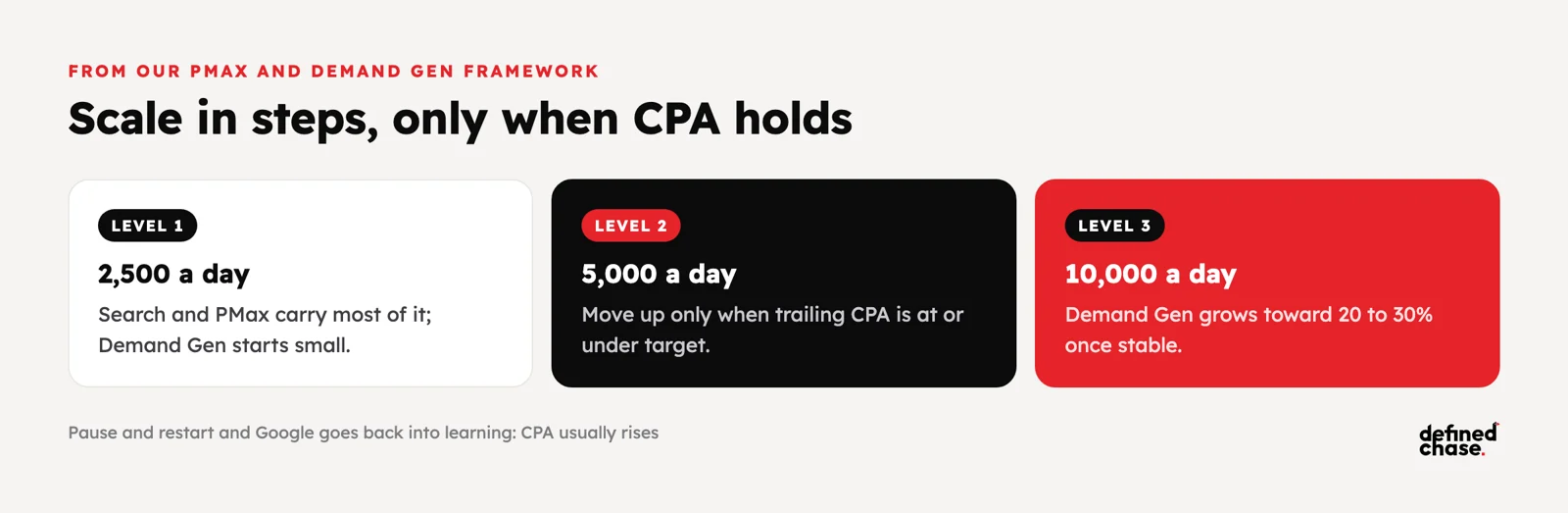
In our Demand Gen and Performance Max framework, the budget ladder is written down before launch: for example 2,500, then 5,000, then 10,000 a day across channels, with Search and Performance Max carrying most of it and Demand Gen growing toward 20 to 30% once stable. The rule is simple: the account only moves up a level when the trailing CPA is at or under the target. The pattern we see in stalled accounts is the opposite: a small budget, a pause, a restart and another pause, with past learning thrown away each time.
Smart Bidding needs consistent, accurate conversion data to set bids for each auction (Google Ads Help: About Smart Bidding), which is why the audit order matters. Scaling on wrong conversions scales the wrong customers. For the wider reasons cost per customer rises with spend, see why customer acquisition cost rises when you scale.
Common Google Ads audit mistakes
Most weak audits look at settings instead of outcomes, and produce a long list nobody acts on.
- Starting with keywords and ad copy. Without true conversions, every keyword decision is a guess.
- Judging on blended ROAS. Brand and returning customers make it look healthy while new-customer growth stalls.
- A 100-point checklist. Rank findings by money at stake and fix the top five first.
- Auditing Google alone. If Meta, YouTube or DV360 run beside it, the same customer is counted by each; check the total against the backend.
- No follow-up date. An audit is only worth the changes made in the 30 days after it.
How we run it at Defined Chase
When we take on a Google Ads account, the first weeks follow the order above: conversions reconciled with the backend, bidding goals and values fixed, enhanced conversions and offline imports in place, brand separated from Performance Max, waste cut from 90 days of search terms, and a written budget ladder with the CPA rule for each step. We report brand, non-brand and Performance Max on separate lines and judge the account on cost per new customer from your own data. The account stays in your name. See how we run Google Ads for brands spending $100K+ a month, or book a free Growth Map Call to go through these checks on your account with us.
FAQ
What is a Google Ads audit?
A review of a Google Ads account that checks whether conversions are real, what the bids learn from, where spend is wasted, how much of the market the account wins and whether ads and landing pages match the search. A useful audit ends with a ranked list of fixes and the money at stake for each.
How often should you audit a Google Ads account?
Run a full audit when growth stalls, when you change agency or before a big budget increase, and a lighter check every quarter. Conversion tracking should be reconciled with the backend every week, because it breaks without warning.
What does a Google Ads audit cost?
Free audits are usually a quick review of settings. A paid audit is priced by account size and how deep it goes into tracking and the CRM. Whatever the price, ask for the findings ranked by money at stake and a plan for the next 30 days.
Who should you hire to scale Google Ads past $100K a month without CPA going up?
A team that starts with conversion data and brand separation, scales budgets in steps with a written CPA rule, and reports cost per new customer from your backend rather than platform ROAS. Ask for an example at your spend level and confirm the account stays in your name.
Can you audit Google Ads yourself?
Yes, for most of the checks: compare conversions with your backend, review primary conversion actions, sort 90 days of search terms by cost with no conversions, check brand exclusions and final URL expansion in Performance Max, and read impression share lost to budget. The harder part is deciding what to fix first and what it will change.
Is Performance Max bad for brand campaigns?
Not bad, but it can buy your own brand and report it as new demand. Exclude brand terms from Performance Max, run brand in its own Search campaign, and judge Performance Max on what it adds beyond the searches you would have won anyway.
Updated 18 November 2026.
How we do this for clients: Google Ads agency →
Want to scale your ad spend?
On a free Growth Map Call we find what is capping your ad spend and the next 1 to 3 steps.
Attend a Growth Map CallRelated articles
Best SaaS Paid Media Agencies: How to Choose One at $100K+ a Month
How to choose a SaaS paid media agency at $100K+ a month: a shortlist of real agencies, five questions to ask, and…
Nov 16, 2026 · 7 min readBest TikTok ads agencies in Europe for brands spending $100K+ a month (2026)
A shortlist of TikTok ads agencies in Europe for brands spending $100K+ a month, five questions to ask, and where Defined Chase…
Nov 4, 2026 · 7 min readPerformance Max vs Search at scale: stop buying your own brand
At $100K+ a month on Google Ads, Performance Max and Search do different jobs. How to stop PMax buying your brand, control…
Oct 26, 2026 · 11 min read