

Short answer: at $100K+ a month, the choice is not really agency or in-house. It is whether one owner is accountable for the full number, with every seat filled: strategy, channel buying, tracking, creative and reporting. Build in-house when paid media is your core skill, you run one or two channels and you can hire and keep senior people. Use an agency when you need several channels, tracking and creative working together now, or when growth has stalled and you need a team that has seen the problem before. Many brands past $1M a month end up with a hybrid: an in-house owner plus a specialist partner. Whatever you choose, you keep the ad accounts and the data, and budget goes up only when an agreed number holds.
This guide is for brands spending $100,000 or more a month on paid media. It draws on 222 growth strategy calls with marketing leaders and founders, where distrust of agencies came up 82 times and “nobody owns budget and execution together” another 59 times. Both problems are about ownership, not about where people sit.
What 222 growth strategy calls say about agencies and in-house teams
Teams that worked with agencies describe the same pattern: the agency runs the accounts, the brand carries the risk, and someone inside has to chase results.
- “A lot is taken over by our agencies, and then you have to chase the results.”
- “The agency actually, they don’t risk anything… the main risks are all on us.”
- “We have spent a lot of money over the past three years, but our expectations are not being met.”
Teams that went in-house describe a different pattern: one person carries too much, and the work stops when they leave or get pulled elsewhere.
- “Everything is handled by one person, where it is not the main focus.”
- “We had such a marketing manager there, we hired, didn’t fit, looking for another.”
- “Today there is a shortage of people who do tracking, very few people know how.”
And the question behind both: “There aren’t any who both manage the budget and handle the execution?” That is the real gap. An agency without an owner on your side drifts. An in-house team without the missing seats stalls.
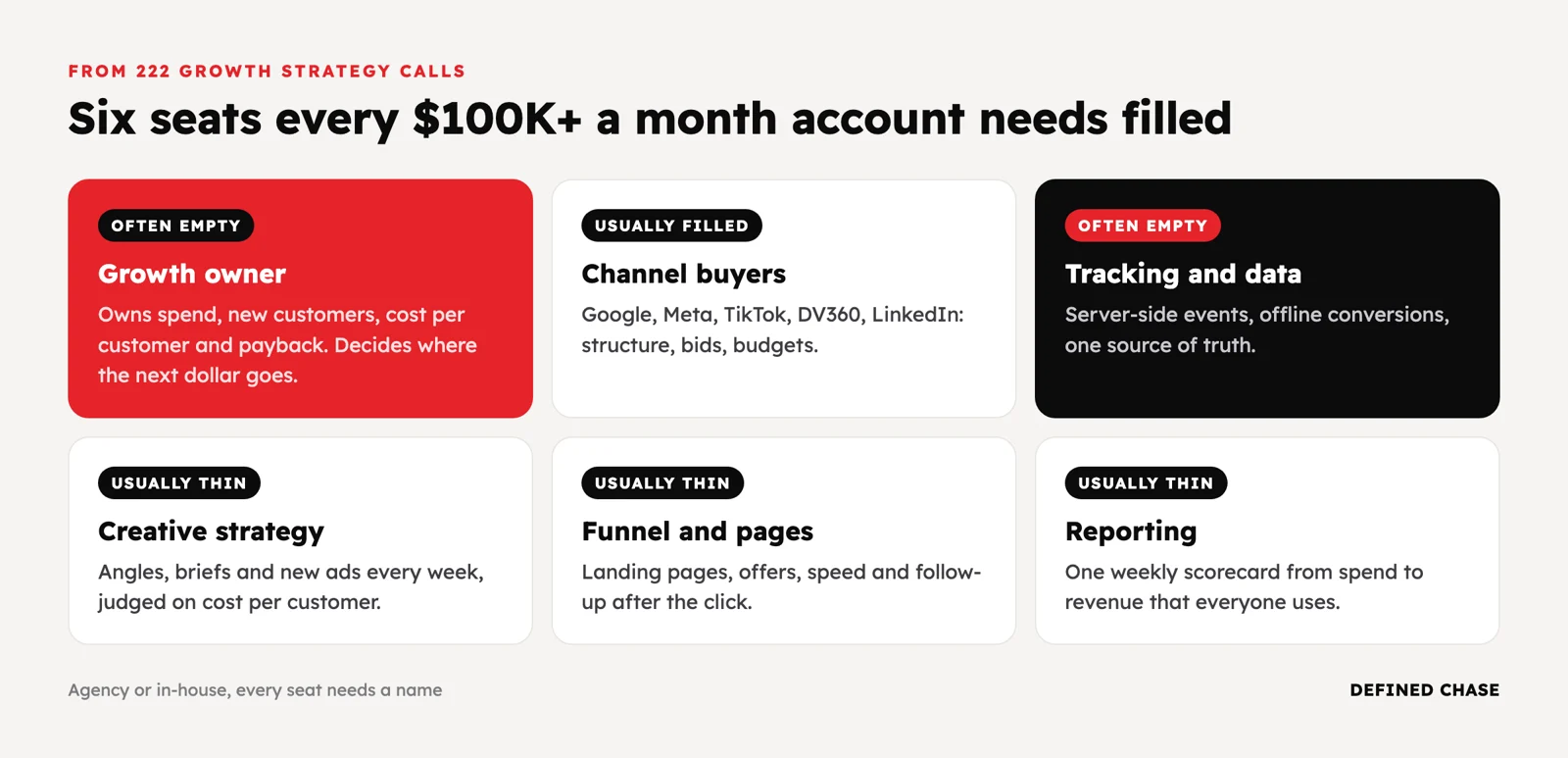
The seats you need at $100K+ a month
Start from the work, not the org chart. At this budget, someone has to own each of these jobs every week, whether they sit in your office or at a partner.
| Seat | What they own | What breaks without it |
|---|---|---|
| Growth owner | The full number: spend, new customers, cost per customer, payback. Decides where the next dollar goes. | Channels optimise their own metrics and nobody answers the CEO |
| Channel buyers | Daily work in Google, Meta, TikTok, DV360 or LinkedIn: structure, bids, budgets, search terms | Wasted spend, missed volume, slow reactions |
| Tracking and data | Conversion tracking, server-side events, offline conversions, one source of truth | Platforms optimise on bad signal and nobody trusts the numbers |
| Creative strategy | Angles, briefs and a weekly flow of new ads, judged on hook rate, hold rate and cost per customer | Ads wear out in 10 to 12 days and costs climb |
| Funnel and pages | Landing pages, offers, speed and follow-up after the click | Good clicks, no sales |
| Reporting | One weekly scorecard from spend to revenue that everyone uses | Meetings about whose numbers are right |
Most in-house teams we meet cover two or three of these seats well. Most agencies cover the channel seats well. Tracking and the growth owner are the seats left empty most often, and they are the two that decide whether you can scale.
Agency vs in-house vs hybrid: the comparison
| Factor | In-house team | Agency | Hybrid (in-house owner plus partner) |
|---|---|---|---|
| Time to full strength | Months: hiring, onboarding, the first bad hire | Weeks, once access and tracking are in place | Weeks for the partner, months for the owner |
| Channel breadth | Deep in one or two channels | Several channels and specialists on call | Your core channels inside, new channels outside |
| Knowledge of your business | Highest, and it grows every month | Depends on how much context you share | High: the owner carries it, the partner adds pattern knowledge |
| Pattern knowledge | Limited to your own account history | Learns from many accounts and budgets | Both |
| Key-person risk | High: one resignation can stop a channel | Lower: a team covers the account | Lower, if the plan is written down |
| Cost structure | Salaries, tools and management time, fixed | A monthly fee, flexible | One salary plus a smaller fee |
| Main risk | Missing seats, usually tracking and creative | Nobody inside holds the agency to a number | Unclear split of who decides what |
When in-house wins
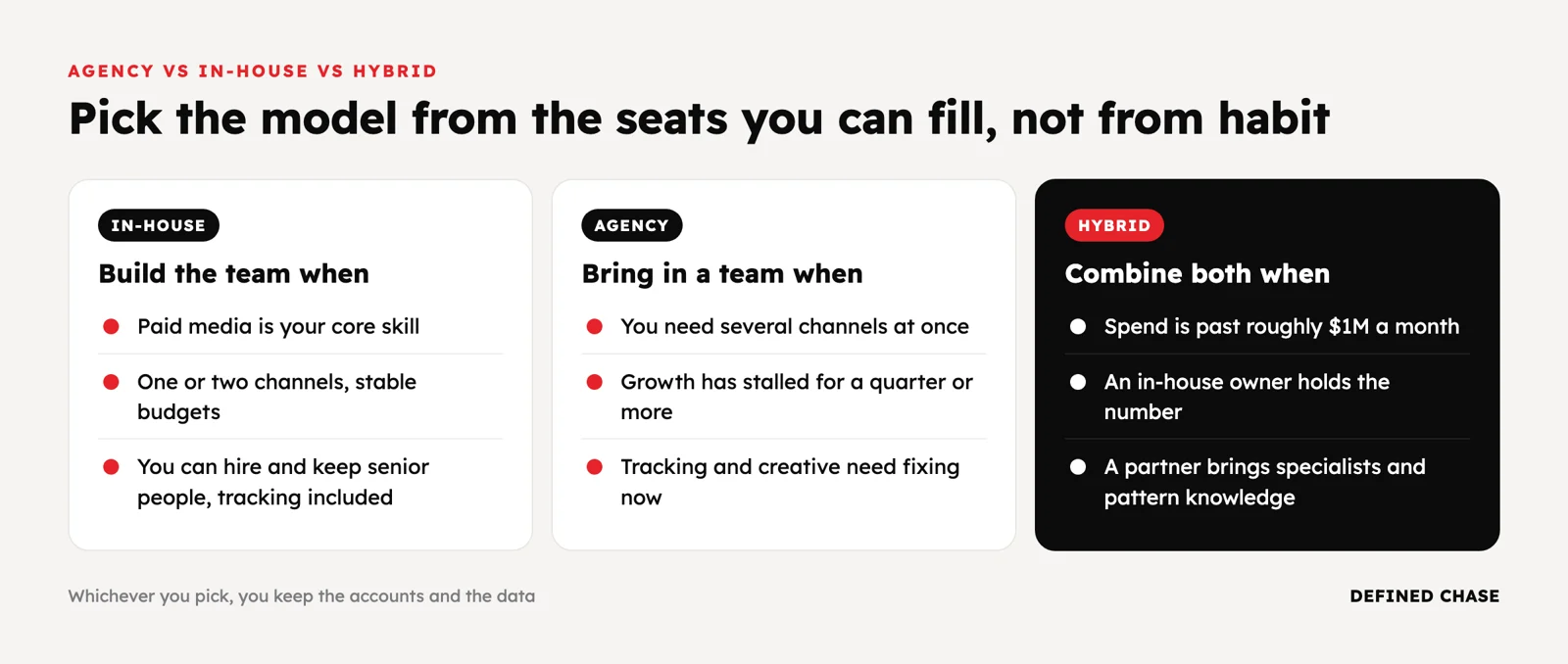
- Paid media is the business. If acquisition is your core skill and the founders understand it deeply, keep it inside.
- One or two channels, stable budgets. The job is mostly execution, and a full outside team adds overhead.
- You can hire and keep senior people. Including someone who can build and maintain tracking, which is the hardest seat to fill.
- Speed of internal decisions matters most. Pricing, offers and pages change daily and need someone in the room.
When an agency wins
- Several channels at once. Google, Meta, TikTok and DV360 each need a specialist. Hiring all of them for one brand rarely pays.
- Growth has stalled. A team that has seen the same ceiling at other brands finds the cause faster than a new hire learning on your budget.
- Tracking needs fixing now. Server-side tracking and offline conversions are specialist work you need once, then maintained.
- You are entering new markets or channels. Testing before you commit headcount is cheaper.
When a hybrid works best
Past roughly $1M a month, most of the strongest setups we see are hybrids. One senior person inside owns the full number and the weekly scorecard. A partner brings specialists, tracking, creative volume and pattern knowledge from other accounts. The owner keeps the partner honest, and the partner keeps the owner from becoming the bottleneck. It only works when the split is written down: who decides budgets, who launches creative, who owns tracking.
How to make either model accountable
Most complaints about agencies on our calls are really complaints about missing rules. These six fix most of them, and they work the same for an in-house team.
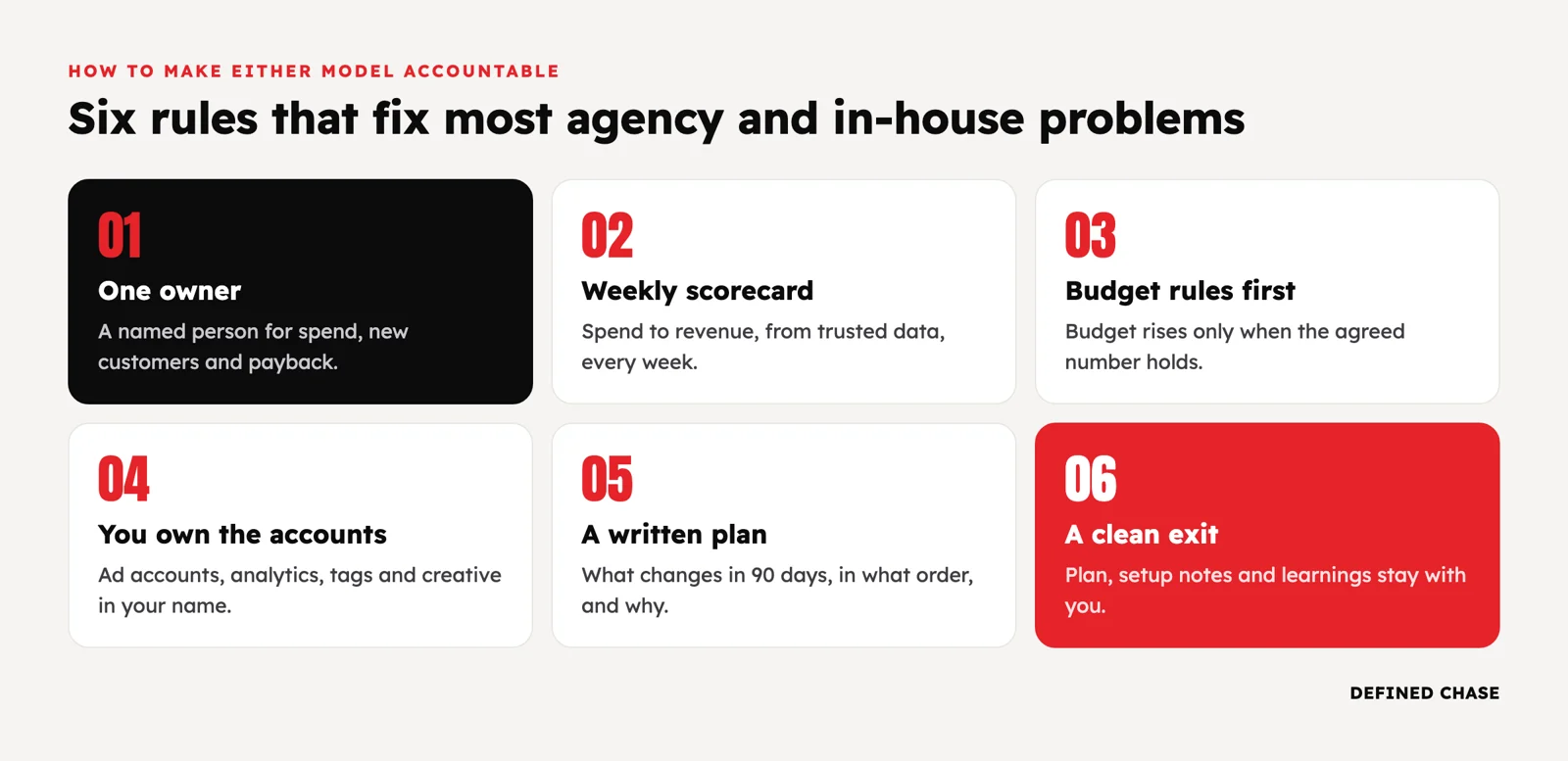
- One owner for the full number. A named person accountable for spend, new customers and payback, not only for clicks or ROAS on one platform.
- One weekly scorecard. Spend, new customers, cost per customer and payback, from trusted data, reviewed every week.
- Budget rules agreed in advance. Budget goes up only when the agreed number holds, and comes back down when it does not.
- You own the accounts and the data. Ad accounts, analytics, tag managers and creative files sit in your name.
- A written plan. What changes in the next 90 days, in what order, and which number decides each step.
- A clean exit. The plan, the setup notes and the learnings stay with you if the partner or the person leaves.
If an agency will not agree to these, that tells you more than the pitch deck does. If your in-house team cannot meet them, the gap is a missing seat, not effort.
Comparing the cost properly
Compare the full cost of filling every seat, not one salary against one fee. An in-house team means salaries for each seat you need, tools, recruiting, management time and the months before new hires are productive. An agency means a monthly fee for a team. The bigger cost is usually neither: it is a quarter spent at the wrong budget level because nobody trusted the numbers. For how agencies charge at this budget, see our guide to PPC management pricing at $100K+ a month.
Questions to ask before you decide
| Question | If the answer is yes |
|---|---|
| Do we trust our conversion numbers today? | You can choose on team fit. If not, fix tracking first, whoever does it. |
| Is one person accountable for the full number? | An agency can plug in under them. If not, appoint one before you hire anyone. |
| Do we run more than two paid channels? | Specialists matter more, which favours an agency or hybrid. |
| Has growth stalled for more than a quarter? | Bring in outside pattern knowledge before adding headcount. |
| Could we lose one person and keep running? | Good. If not, write the plan down and reduce key-person risk. |
On our calls, the gap behind most of these is the same one we described in what caps ad spend across 222 growth strategy calls: trusted numbers first, then one owner, then the path from ad to revenue.
How we run it at Defined Chase
We work with brands spending $100K+ a month, either as the full paid media team or next to an in-house owner. A team covers every seat: a strategy lead who owns the number with you, channel specialists, tracking, creative strategy and one weekly scorecard. You keep the ad accounts, the data and a written plan, and budget goes up only when the agreed number holds. See how we run performance marketing for brands at this budget, or start with a free Growth Map Call to find which seat is capping your spend.
FAQ
Is an agency cheaper than an in-house team?
It depends on how many seats you need. For one channel with a stable budget, one in-house buyer is often cheaper. For several channels plus tracking and creative, filling every seat in-house usually costs more than an agency team, before counting hiring time and key-person risk.
When should we move paid media in-house?
When paid media is a core skill of the business, you run one or two channels, and you can hire and keep senior people, including someone for tracking. Many brands move the growth owner seat inside first and keep specialists outside.
Why do agency relationships fail?
On our growth strategy calls, the usual reasons are no agreed number that decides budget, reports full of platform metrics instead of revenue, and nobody inside holding the agency to account. Agree the scorecard and budget rules before signing.
What should we own if we hire an agency?
The ad accounts, analytics, tag managers, creative files and the written plan. If the relationship ends, you should be able to keep running without rebuilding anything.
Can an agency work with our in-house team?
Yes, and past about $1M a month that is often the strongest setup. The in-house owner holds the number and the context; the agency brings specialists, tracking and pattern knowledge from other accounts. Write down who decides what.
Updated 17 October 2026.
How we do this for clients: Performance marketing for $100K+/month brands →
Want to scale your ad spend?
On a free Growth Map Call we find what is capping your ad spend and the next 1 to 3 steps.
Attend a Growth Map CallRelated articles
What Caps Ad Spend: 8 Problems From 222 Growth Strategy Calls
Short answer: across 222 growth strategy calls with brands that spend on paid media, the things that cap ad spend are rarely…
Oct 17, 2026 · 4 min readWhy Customer Acquisition Cost Rises When You Scale Ads (and What to Fix First)
Short answer: customer acquisition cost rises when you scale ads because every extra dollar reaches people who are less likely to buy,…
Oct 16, 2026 · 7 min readPPC Management Pricing at $100K+ a Month: What a Paid Media Agency Costs
Short answer: paid media agencies charge in five ways: a percentage of ad spend, a flat monthly retainer, a hybrid of the…
Oct 16, 2026 · 8 min read