

Short answer: at $100K+ a month, creative is the main lever you still control on Meta, TikTok and YouTube. Every ad is a hook, a body and a call to action, and about 80% of the work goes into the hook. Start from an angle (a reason people buy), test new angles cheaply with statics, turn a winning hook into a concept, and give that concept brand-new ads every week instead of small edits. Set the weekly volume from the budget: about 20% of spend for testing, and enough new ads that one or two winners appear every week. Judge ads on hook rate, hold rate and fatigue, but let purchases have the final say.
This is the creative playbook we use with clients. It is written for brands spending $100,000 or more a month, where ads wear out in 10 to 12 days and the account needs a steady flow of new winners to keep cost per customer flat while budget goes up.
Why creative decides whether you can scale
On the big platforms, targeting is mostly automated now. The algorithm finds buyers based on who reacts to your ads, so the ad itself has become the targeting. Two things follow from that:
- New ads find new people. A fresh angle reaches buyers your current ads never moved. That is how you add volume without paying more for the same audience.
- Old ads get expensive. At higher spend the same people see the same ads more often. Cost per purchase climbs, even when nothing else changed.
On our growth strategy calls, creative is a top-10 complaint, and it usually sounds like this: “Even to test a small campaign, I spend too much time creating new videos.” The fix is not more effort per ad. It is a system that produces many different ads from a few good ideas.
The anatomy of an ad: hook, body, CTA
| Part | Job | Static | Video |
|---|---|---|---|
| Hook | Stop the scroll and call out the right person | About 1 second. The headline and image are the hook. | The first 3 to 5 seconds: visual, first line and on-screen text |
| Body | Prove the product works. Proof lowers risk. | One claim plus one proof element | Product, reason to believe, social proof, reason to believe |
| CTA | What to do, how, what they get, until when, and what happens next | Offer, price, button | Say it and show it on screen |
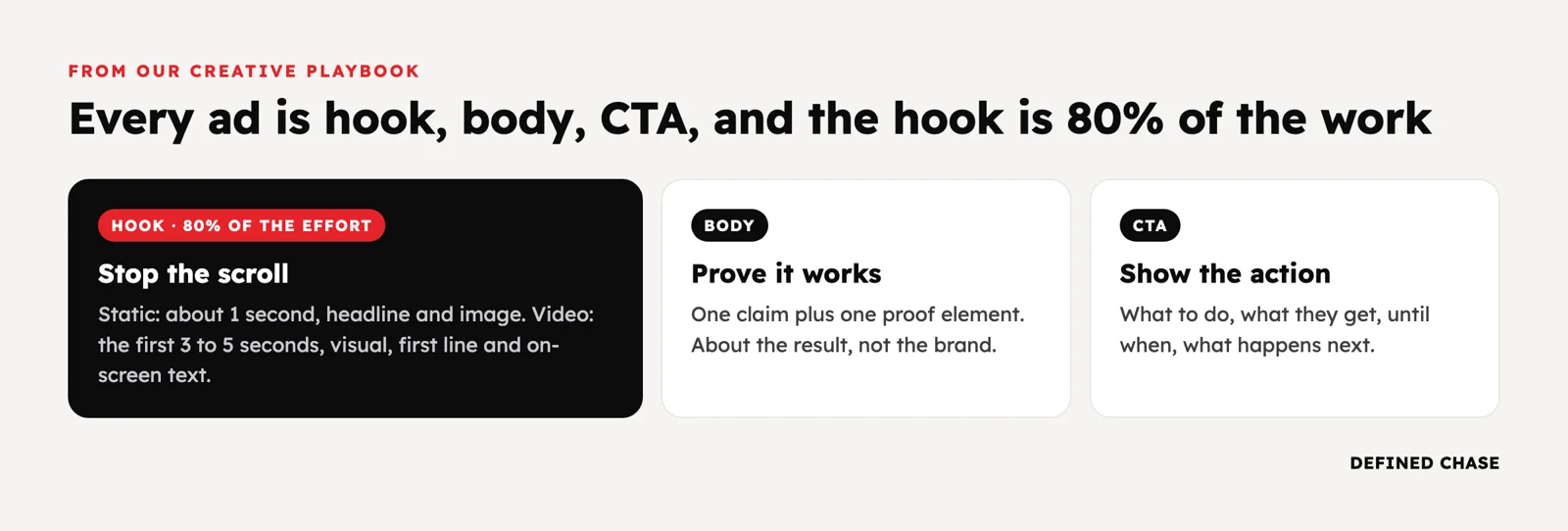
About 80% of the effort goes into the hook, because it decides whether anyone sees the rest. Make the body about the result, not the brand or clever production.
Angles: where every ad starts
An angle is a reason someone buys. Ask: why do people buy from us? It changes my life, it solves a problem I have, I get results fast, I trust it, I am sure I can use it. Pain points work best, and they split in two: physical (what people feel or see) and emotional (how it makes them feel about themselves). Each is its own angle.
Write each angle for one awareness stage. Ads made only for people who already know the brand run out of audience fast.
| Stage | What they know | The hook leads with |
|---|---|---|
| Unaware | Not that they have the problem | A situation or symptom they recognise |
| Problem aware | The problem, not the solutions | The pain and its cost |
| Solution aware | That solutions exist | Why this way works better |
| Product aware | You, but they are not convinced | Proof, reviews, answers to doubts |
| Most aware | Ready to buy | The offer and the deadline |
Do not invent angles from zero. Look at ads from competitors and fast-growing brands that have run for a long time or been copied many times, plus reviews, comments and the questions customers ask your sales team. Adapt the idea to your product.
From a winning hook to a concept
When a hook works, it becomes a concept. Every week that concept gets brand-new ads built on different hook types: a callout (“[who] who [problem], this is for you”), a question, an if-then, a surprising but real result, a promise, proof with real numbers, an offer, a review, curiosity. Make hooks a little broader than your current buyer, because wider hooks leave more room to scale.
Why brand-new ads, not small edits
Meta now measures how similar ads are and groups look-alikes together. A recoloured background, a new headline or a different button no longer counts as a new ad. It is easier to get a genuinely new ad delivered (a new person, scene or script) than a tweaked version of an old one.
One shoot, many ads
Film several different openings and 3 to 5 bodies in the same session. Combined, they give many ads from one shoot. Each combination must look different in the first seconds, a new visual and not just new words, or the platform treats it as a copy.
Formats: statics, video and offers
- Statics for offers and new angles. Make 1:1 first, then 9:16. They are fast and cheap to test.
- Video for storytelling and higher order values. Make 9:16 first, then 1:1. Typically 20 to 40 seconds. Longer, advertorial-style videos work for higher-priced products.
- Body formats that work: demonstration, testimonial, education, story (before, turning point, after) and faceless (hands, product, text and voice-over).
- Ugly can win. Performance design is not brand design. Judge by numbers, not taste. The visual must literally show what you sell.
- Two sizes, always: 1:1 and 9:16, with text inside the safe zones.
Offer ads
Offers run best as statics with the old price struck through, the new price and the deadline in the first frame. Have offer ads ready and approved by the 25th for an offer that starts on the 1st, keep a plan B offer ready, and never pre-announce a sale. People wait, and conversion rate drops the same day.
How many new ads you need each week
Volume comes from the budget, not from taste:
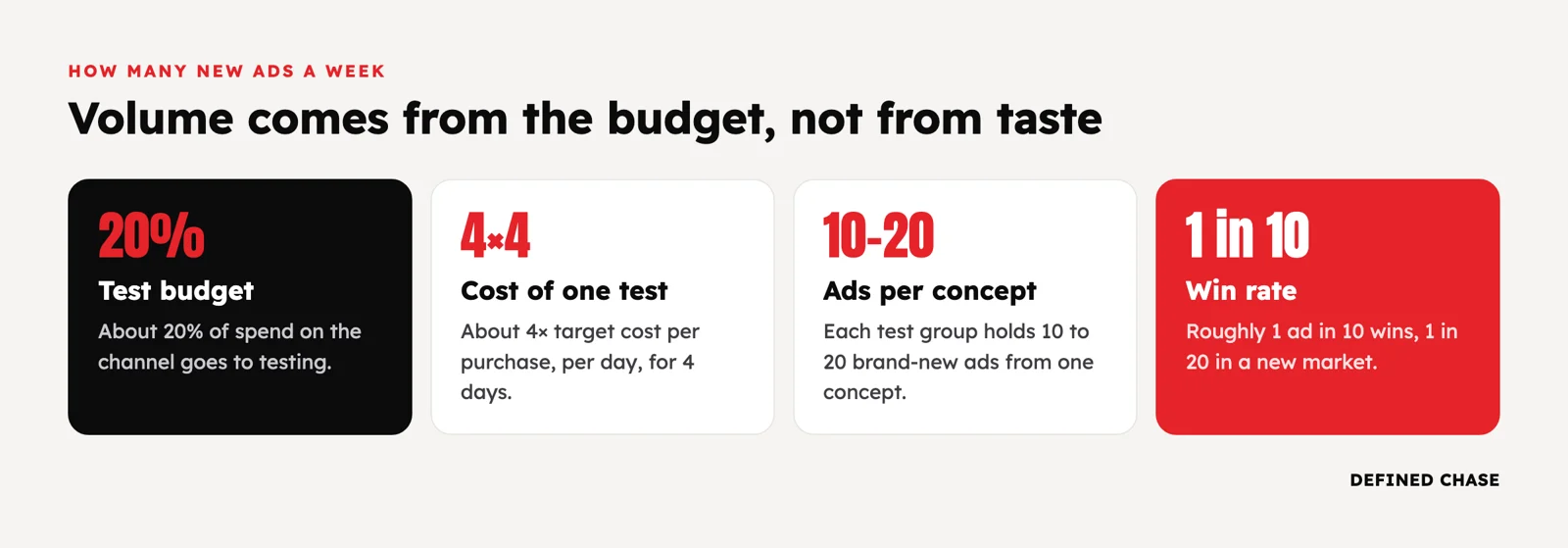
- Test budget is about 20% of spend on the channel.
- One test group costs about 4 times your target cost per purchase, per day, for 4 days.
- Test budget divided by the cost of one group is how many test groups you can run.
- Each group holds about 10 to 20 ads from one concept.
As a reference, brands spending about €1,000 a day launch around 100 new ads a week. Smaller budgets need fewer, but still enough that one or two winners appear every week. Roughly 1 ad in 10 wins, and 1 in 20 when you open a new market.
How to judge an ad
| Metric | Formula | Good | Average | Poor |
|---|---|---|---|---|
| Hook rate (video) | 3-second plays ÷ impressions | Over 35% | 25 to 35% | Under 20% |
| Hold rate (video) | 50% plays ÷ 3-second plays | Over 65% | 45 to 65% | Under 45% |
| Fatigue index | CTR on day 1 ÷ CTR today × 100 | Under 120 | 120 to 140 | Over 140: replace |
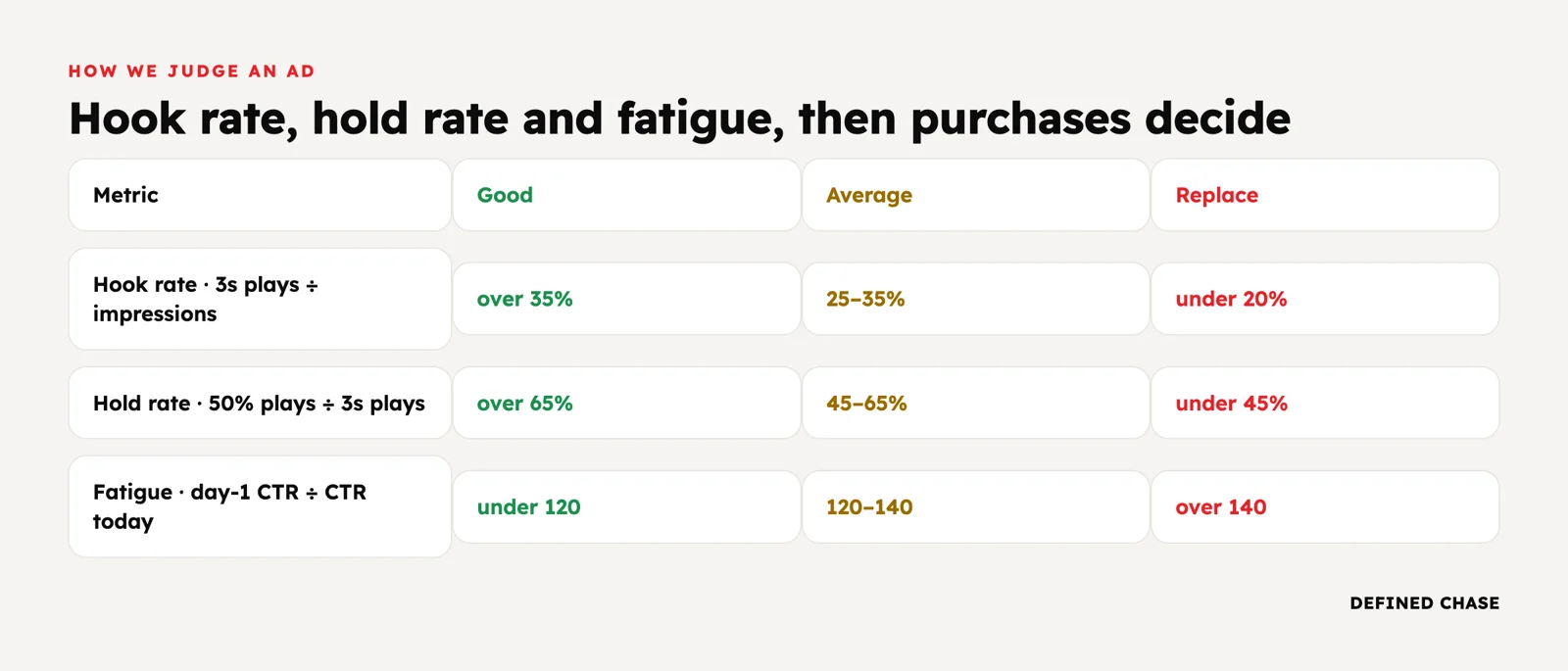
Stop rules we use: a static with CTR under 1.5% after about 2,000 impressions is switched off, and an ad that spends twice the target cost per purchase with no sale is switched off. Purchases have the final say: if it sells, it stays.
Reading the feedback
- Weak hook rate, good hold rate: new hooks, same body.
- Good hook rate, weak hold rate: same hook, new body.
- People leave at one moment in a video: the next ad moves, cuts or reframes that moment.
- Good CTR but no add to cart: the ad and the page do not match. That is a funnel problem, not a creative one.
Common creative mistakes at scale
- Tweaking winners instead of making new ads for the winning concept.
- Testing button colours instead of angles.
- Ads made only for people who already know the brand.
- One shoot, one ad: no hooks filmed to recombine.
- Judging creative on taste or on clicks, not on cost per new customer.
- Letting production speed decide volume, instead of the budget formula.
How we run creative at Defined Chase
We run the creative strategy, briefs and testing system for clients spending $100K+ a month: angles from competitor research and real customer language, weekly concepts with brand-new ads, statics and video in both sizes, and a scorecard built on hook rate, hold rate, fatigue and cost per new customer. Production happens with your team or our partners. If you want to see where creative is capping your spend, start with a free Growth Map Call.
FAQ
How many creatives should I test per week?
Set it from the budget: about 20% of spend for testing, one test group costing about 4 times your target cost per purchase per day for 4 days, and 10 to 20 ads per group. Brands spending around €1,000 a day launch roughly 100 new ads a week.
What is a good hook rate?
Over 35% of impressions reaching 3 seconds is good, 25 to 35% is average, and under 20% means the hook needs replacing.
Statics or video?
Both. Statics for offers and testing new angles quickly, video for storytelling and higher-priced products. Always deliver 1:1 and 9:16.
How long does a winning ad last?
At scale, ads often wear out in 10 to 12 days. Watch the fatigue index: when day-1 CTR divided by today’s CTR passes 140, replace the ad with a new one from the same concept.
Why not just edit the winning ad?
Meta groups similar ads together, so small edits rarely count as new. A new person, scene or script inside the winning concept gets delivered more easily and reaches new buyers.
Updated 17 October 2026.
How we do this for clients: Meta ads agency →
Want to scale your ad spend?
On a free Growth Map Call we find what is capping your ad spend and the next 1 to 3 steps.
Attend a Growth Map Call